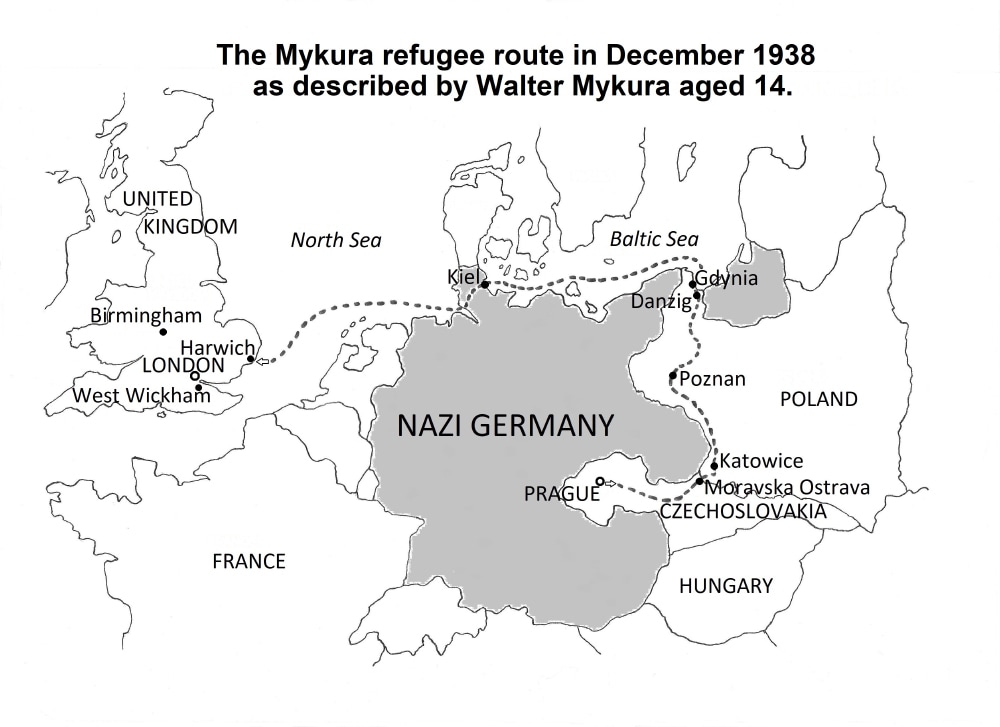
Walter Mykura aged 14 writes in his 1941 school magazine
As the German army occupied the outside parts of Bohemia and Moravia, many Democrats and Jews, who feared to be put into concentration camps, came into the undefended centres of these countries. There were at least 60,000 refugees in Prague and its environs. But, as a law was passed that only Czech refugees might stay in the country, many Germans returned home. A few of them who did not wish to be made prisoners for nothing, emigrated to neutral countries. In this way, we came, with many others, to England.
On December 1st the day for us to leave our native country had come. First we packed all our luggage and got our passports in order. At 9pm all the people who were to come in our transport, met at Wilsonovo Nadrazi, Prague’s biggest railway station. An hour later we left the Czech capital. For the last time most of us saw the lights of the hundred-towered city, Prague.
Our express train rushed eastwards. First we were very excited and nobody thought of sleeping. We boys ran round the carriages and made friends with the other children who travelled with us. After midnight we began to feel tired and went back to our own coach to have a bit of sleep. One couldn’t call it comfortable because in a third class carriage like ours the seats were only made of wood. Apart from that, everything was very modern. At 6a.m. we reached Moravska Ostrava, a city on the Polish frontier. There we had the first passport inspection. The customs officers marked our passes and asked what our trunks contained. A few minutes later our train crossed the Polish border. Passing through Poland we could see on both sides of the railway line gigantic fields and a few windmills. At 9 a.m. we came to Kattowice, which is an important town near the German border. Another interesting town we passed was Poznan, an important industrial centre, about 150 miles from Warsaw. At 8 p.m. we reached the free city of Danzig, but it was too dark to see much of it. One hour later we were in Gdynia. At the station our passports were again inspected. Afterwards our group went to the shipping customs house, where the officers marked our passports and asked about the contents of our trunks. Then we went on board the boat, where the Polish customs officers inspected our passes for the fourth and last time.
The ship was called after the Polish capital “Warsaw” and had a tonnage of 2,500 tons. Soon afterwards we left the dock. Two nights and one day we sailed the Baltic and reached the German city Kiel at 6 a.m. on the third day of our journey. We had a very pleasant journey through the Kiel Canal. There we saw ships of all the nations of the world. At noon a thick fog suddenly came over us, and made shipping very dangerous. When we reached the end of the canal the fog got worse, and we had to stop there, the captain said, until next morning, but it turned out better than that. At midnight the fog cleared up and our ship sailed off. When I woke up the ship was tossing and most of the people were ill. Soon I was on deck watching the high waves. In the afternoon the ship got better and the sick people too. Next morning the sea was calm again. Soon we were busy packing our things, because that was the last day at sea. At 2 p.m. we saw England for the first time, and at 7 the ship stood in a Harwich dock. Some English customs officials came on board, marked our passports and gave us permission to stay in Great Britain. Then we went by train to London where we stayed for a few days. After that we went to West Wickham in Kent. Two months later we came to Birmingham and joined Yardley Grammar School.
W. M.