Franziska Mykura’s family
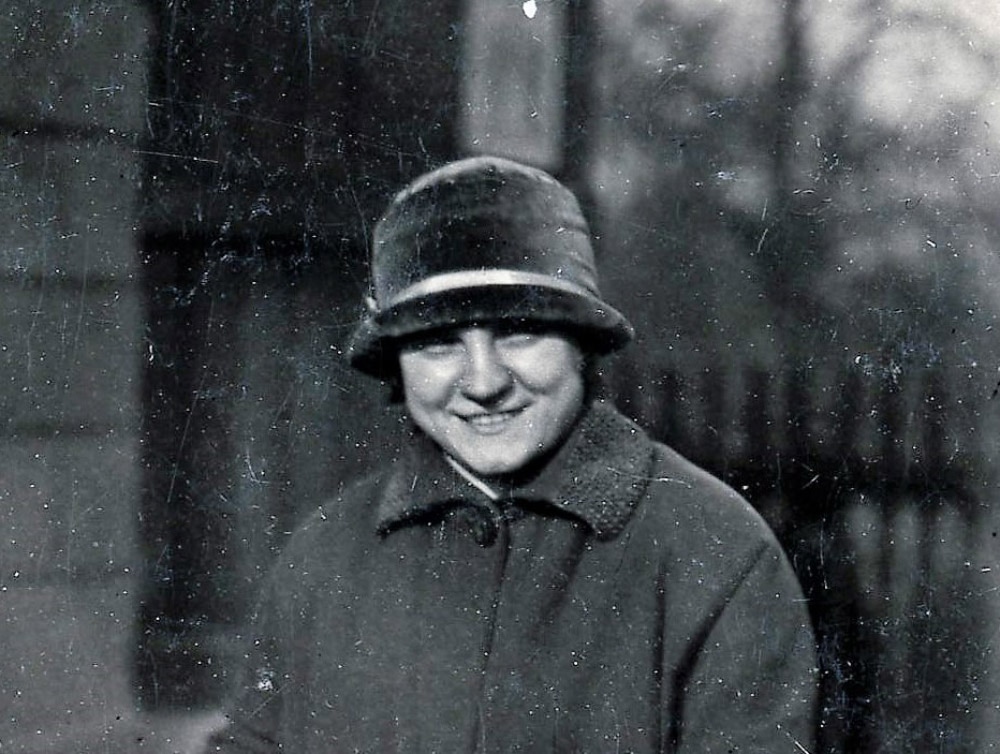
Franziska Bartl was born on May 1st 1905 in Schmiedberg (now Kovarska) in Bohemia in the Austro- Hungarian Empire. Franziska’s photo is from 1927, aged 22.

The image shows Franziska’s family tree. The Bartl family tree, written by Franziska’s son Helmut Mykura (1927-1991) shows that Franziska was the eldest of five children. As a child Franziska was adopted by her aunt and uncle and she became Franziska Schmiedl. She moved to Falkenau (now Sokolov) to be with her adoptive parents, but still visited her old family in Schmiedeberg (now Kovarska) in the holidays. After World War Two Franziska remained in correspondence with her Bartl siblings, and also visited them in Germany where they lived.
Franziska’s birth mother Emma Bartl, nee Theummer died in 1924 before Franziska got married. Franziska’s birth father Vincenz Bartl died in 1955. It is not known when Herr Schmiedl her adoptive father died, but Franziska found out after World War two that Frau Schmiedl, her adoptive mother who had been unable to go with them to the UK had ‘died in 1942 after four very lonely years.’
Franziska also lost her youngest sibling, ‘Unseren Ernst’ (our Ernst) during World War Two. He was a soldier in the German Army. Aged 27 he was killed, leaving two children, on May 10th 1940, the first day of the German offensive against France.
Franz Mykura’s family
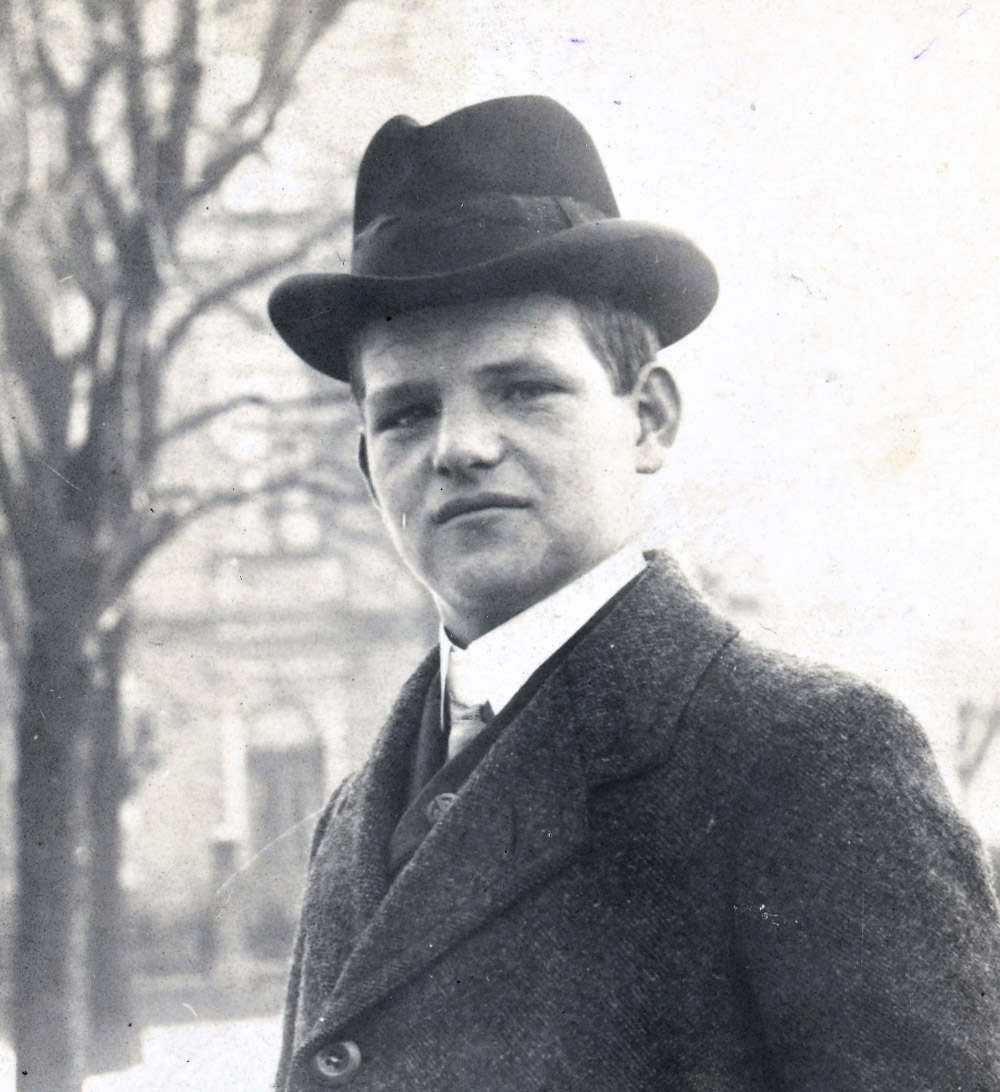
Franz Mykura was born in on 9th September 1896 in Trnovan, Bohemia, in the Austro-Hungarian Empire. Franz’s photo shows him in 1916 (estimate) aged 20.

The image shows Franz’s family tree. The Mykura family tree was written by Franz’s son Helmut Mykura (1927-1991). It shows Franz the sixth of eight children, his two brothers and five sisters born over a period of 18 years. Franz’s father died and was buried in Falkenau (now Sokolov) when Franz was 5 years old. His mother died when he was 16 years old.
Franz’s brother Hans (Johan) Mykura died (reason unknown) in 1941 during World War Two in Falkenau (now Sokolov) which was where Franz and Franziska lived until becoming refugees in 1938.
Franz remained close after World War One (and after World War Two) to the three sisters closest to him in age, Eleonore Mykura (1892-1968) Hermine Mykura(1895-1964) and Anna Mykura (1897-1966.) Eleanore and Anna visited the UK. After the second world war Franz met all his siblings in Germany where they lived. Numerous post-cards remain in the family archive.
Franz Mykura’s apprenticeship 1910-1913
After attending school in the town of Eger (now Cheb), Franz aged 14 started a three year apprenticeship at an iron foundry (Eisengiesserei) and metal fabrication factory (Maschinenfabrik) in Eger.
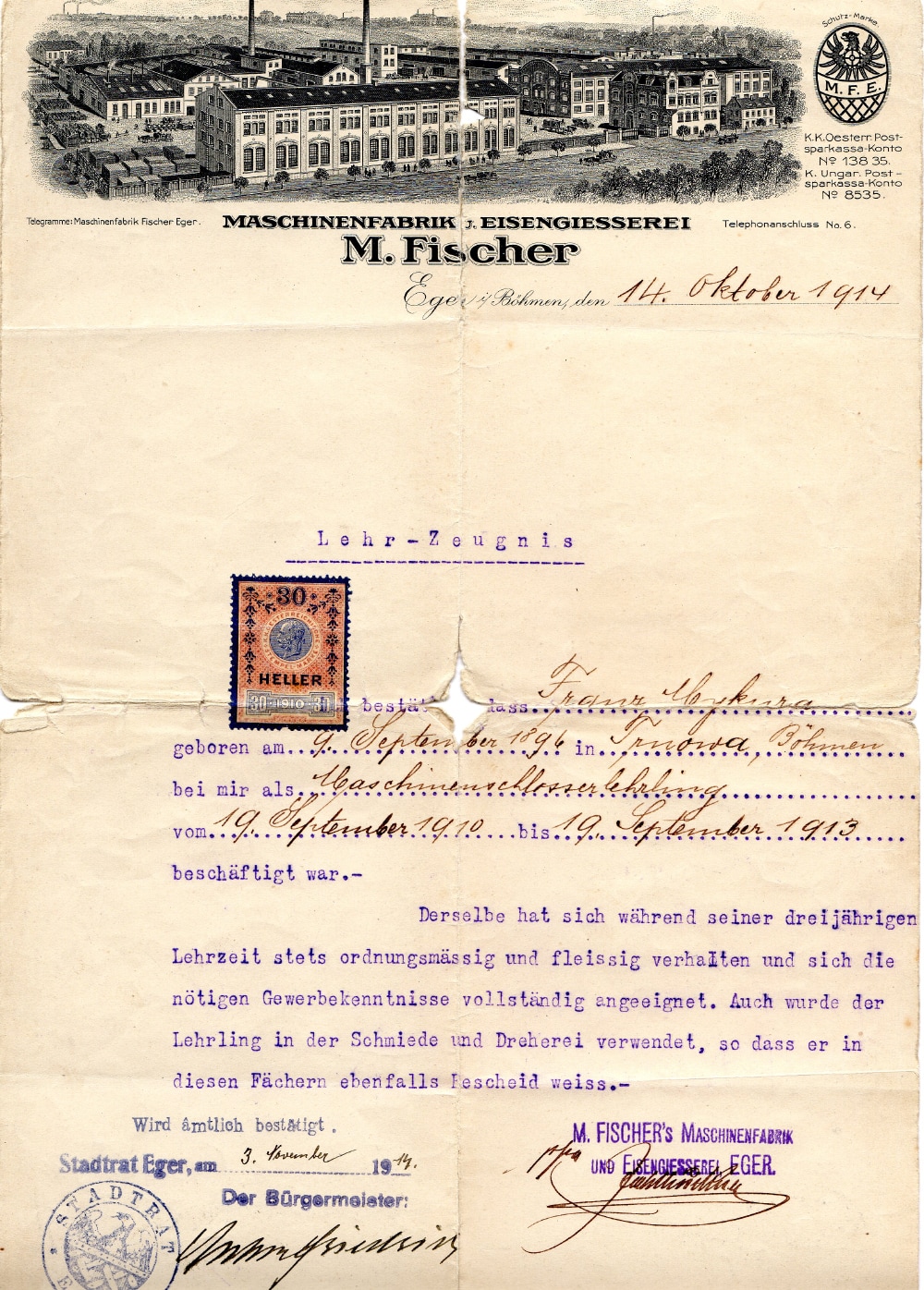
Translation of Franz Mykura’s apprenticeship certificate:
“I confirm that Franz Mykura, born on the 9th September 1896 at Trnova, Bohemia has been employed by me as machine fitter apprentice from September 1910 until September 1913.
He has gained, as a result of his hard work during the three year apprenticeship, the necessary range of industrial knowledge. In addition he has acquired experience and knowledge in the forge and in the turning shop.“
Signed on behalf of M Fischer’s Maschinnenfabrik und Eisengiesserei, Eger
Confirmed officially at the Town Hall in Eger by the mayor, 1914.
Franz Mykura’s Lehr-Zeugnis (Apprenticeship Certificate) shows the level of training on offer in Bohemia, which was the most highly industrialised part of the Austro- Hungarian Empire. Czechoslovakia did not yet exist. The M. Fischer Maschinenfabrik (Metalwork Factory) and Eissengiesserei (Iron foundry) letter head shows an extensive site with a variety of buildings, some three stories high, fronted by a tree lined street.
The main gate had a more ornate building, in front of which a motor car was a nod to modernity. The car contrasts with the horse-drawn transport exiting the site to deliver goods.
The certificate advertises the technology of the time, both telephone and telegram and on the top right the number of their bank account (Konto) with K.K Österreichische postsparkasse (Austrian bank) which had its head office in Vienna, the capital of the Austro-Hungarian Empire.
Franziska’s Tauf- Schein (Baptism Certificate) 1914.
Franziska was born in 1905 in a high village with an industrial heritage, called Schmiedeberg meaning ‘forge-mountain’ (now Kovarska) in the Erze Gebirge (Ore Mountains) in Bohemia. Czechoslovakia did not yet exist.
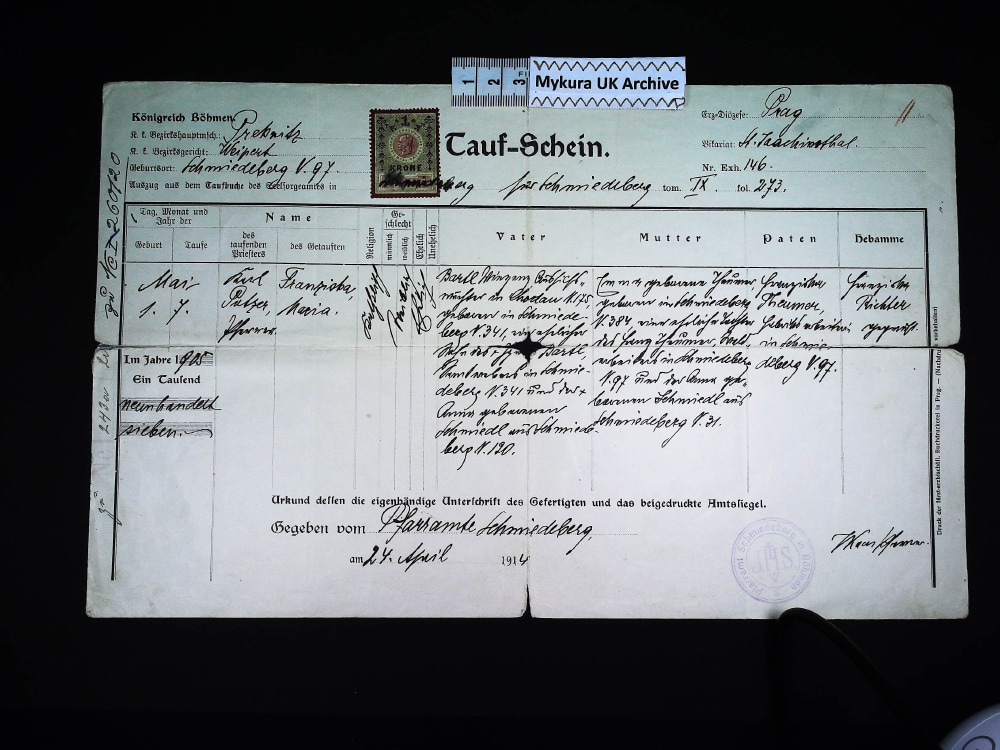
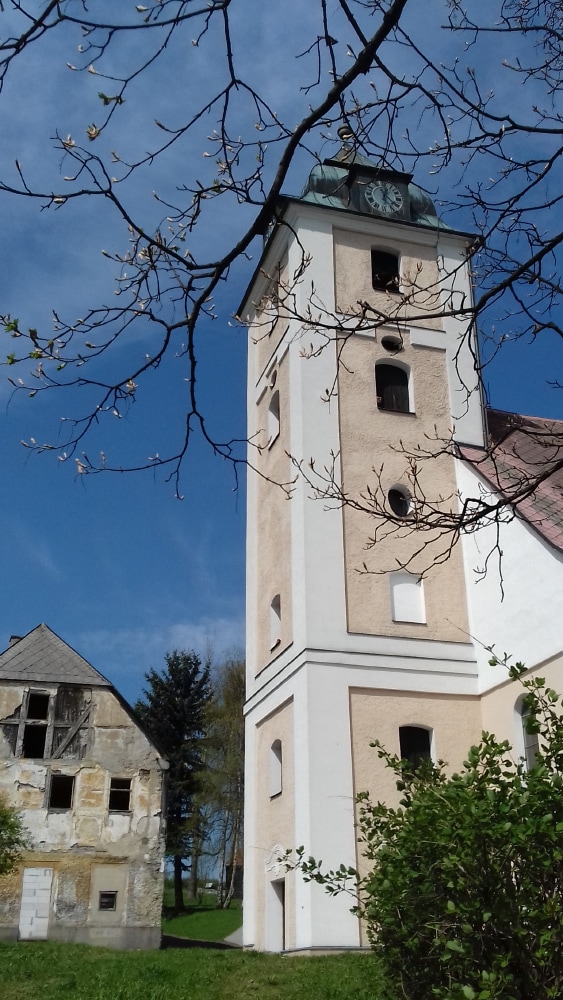
The image shows Franziska’s Tauf-Schein (baptism certificate.) The parish office in Schmiedeberg in the Kingdom of Bohemia in the arch-diocese of Prag provided the certificate dated 24th April 1914. Schmiedeberg (now Kovarska) is where Franziska was born. The certificate references both Franziska’s family name at birth which was Bartl and her later family name of Schmiedl, which was acquired when she was adopted by her aunt and uncle. A red edged 1 Krone KK Oesterreiche (Austro-Hungarian) Stemplemarke (adhesive stamp) is attached. This baptism certificate was produced in lieu of a birth certificate when Franziska applied for naturalization (citizenship) in the UK in 1949. The image shows Kovarska (formerly Schmiedeberg) Church in 2018.