
Franz Mykura’s photos in Der Kuckuck (The Cuckoo) magazine
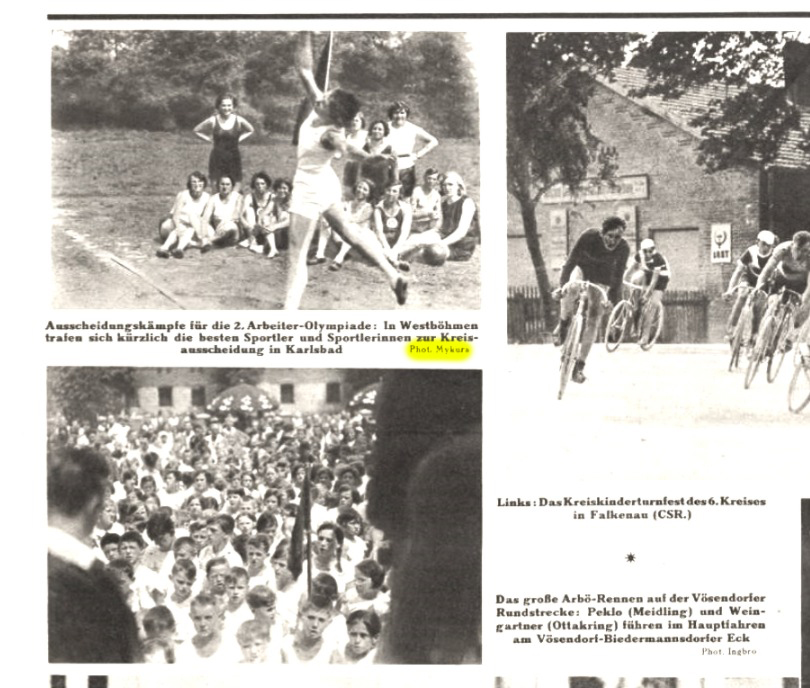
310628 Mykura, date 1931 (estimate)
Der Kuckuck was a short lived (1929-1934) magazine for the working class published in Vienna by the Austrian Social-Democratic Party. Der Kuckuck failed in Austria the same year as the violent defeat of the social-democratic opposition in Austria by the Austro-fascists in February 1934.
Workers’ sport, was the only type of sport covered in Der Kuckuck. Amateur photos sent in by readers were incorporated eg two photographs from ‘Mykura’ on the sports page show women’s shotput and a children’s gymnastic festival in Falkenau (now Sokolov).
The Falkenau location in Der Kuckuck is made clear by the initials CSR. Československá republika, ČSR was the official name of Czechoslovakia after 1918. It was a democracy and the first Czech Republic (1918-1938). The President of the CSR was Tomáš Garrigue Masaryk until 1935 when Edvard Beneš became President. The second Czech Republic (1938-1939) lasted less than six months because the Nazis invaded beyond the Sudetenland to take Prague in March 1939. Benes had resigned in the first week of the second Republic.
Social-Democrat women on the march
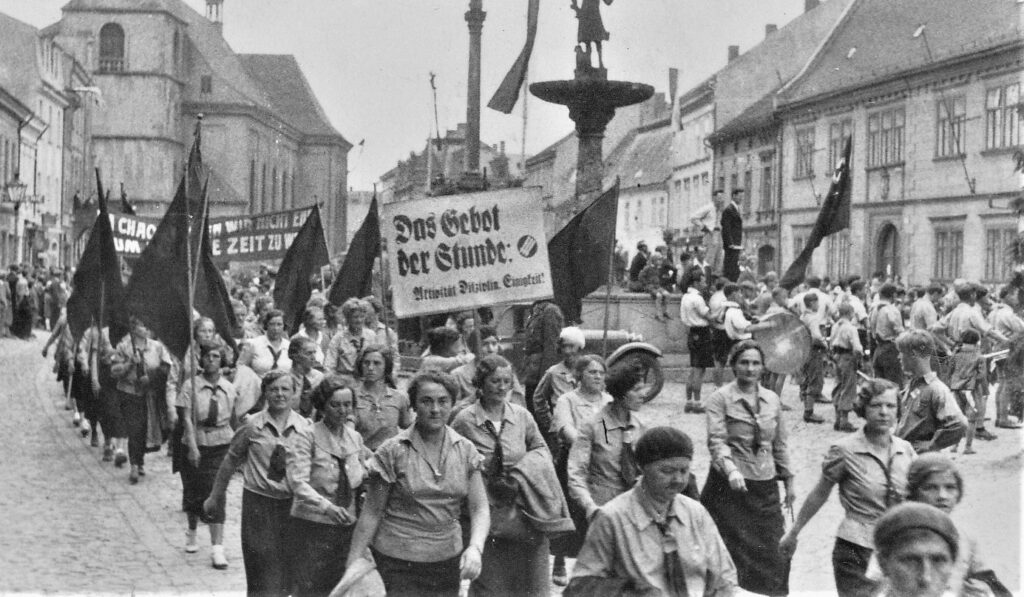
Thank you to The Lowit Family Archive for permission to use their 1934 photo of a social-democrat women’s march in Falkenau (now Sokolov). This is likely to be a photo of the march organised by Maria Günzl who was Women’s Secretary of the DSAP in Karlsbad (now Karlovy Vary.) Maria Günzl was born near Falkenau. She was deported to prisons and camps including Ravensbrück concentration camp after the Nazis invaded Czechoslovakia. Maria survived the war.
The women marchers: The ATUS women’s uniform is likely to be blue blouses and red cravats. The DSAP social-democrat political party sponsored the workers sports Association ATUS. Marches of women’s, men’s, children’s and mixed sports groups made political statements as social-democrats.
The location: The main square in Falkenau has Falkenau Town Hall on the right. At the back left is the church. In the centre is the Falconer Statue on a tall pedestal with a dog at the feet of the standing falconer. Children and adults stand on the wall of the base of the statue. These landmarks are familiar today. A single car is parked in front of the base of the statue and a single man in official uniform watches the women pass. A band plays facing the Town Hall.
Flags: likely to be dark red.
Banner at the Falkenau March: ‘Das Gebot der Stunde’ (translation ‘Needed Now’) on the foreground banner, with smaller print ‘Aktivität. Disziplin. Einigkeit’ (translation: Action, Discipline. Unity.) Also on this banner is the anti-Hitler ‘Drei Pfeile’ (translation ‘Three Arrows’) symbol. In Czechoslovakia social-democrats used the Three Arrows symbol as a sign of solidarity with oppressed social-democrats in Germany, who had earlier used the Three Arrows symbol against Hitler, before social-democracy was banned in Germany by Hitler in 1933.
The obscured banner at rear: only these words are partially visible:
—M Chaos — wir nicht er— um —die Zeit zu W— For more information about this march – please see the ‘Role of Women in ATUS’ in the header Sport and ATUS.
Mykura children’s education in 1930s Czechoslovakia
Education in Falkenau (now Sokolov) was excellent with regular primary school reports on a range of subjects, signed by the teacher, the headteacher and the parent.

The 1936 national school report form in German is headed by the name of the Czechoslovak Republic, which is repeated in the watermark. Areas with a large minority speaking population were entitled to schools teaching in the minority language. The Schulbezirk (School district ) is named as Falkenau an E. (Falkenau an der Eger – Falkenau on the river Eger.)
The first two topics for a nine year old are ‘Behaviour’ and ‘Effort’’ followed by ‘Religion,’ which is described ‘konfessionslos, meaning not belonging to any denomination. This is unsurprising, since Franz Mykura had been a ‘Freidenker’ (Freethinker – not attached to any religion) since he lived as a young man in Eger (now Cheb.)
Other school subjects are Citizenship, Written Expression, Grammar, Spelling, Heimatkunde’ (local history/geography/ natural history) Arithmetic, Drawing, Writing, Singing and Boys’ Handcraft.
An optional subject is Czechoslovak Language, which was important in the multi-lingual country of Czechoslovakia with many bilingual speakers. The German speaking Czech citizens who were social-democrats like the Mykura parents were keen to show their allegiance to the new country of Czechoslovakia. Walter Mykura as a 1930’s schoolboy did an ‘exchange’ staying in a Czech-speaking area near Prague with a Czech-speaking boy.
Mykura children’s sport in the 1930’s Czechoslovakia
A whole range of children’s activities were provided in Falkenau by ATUS.
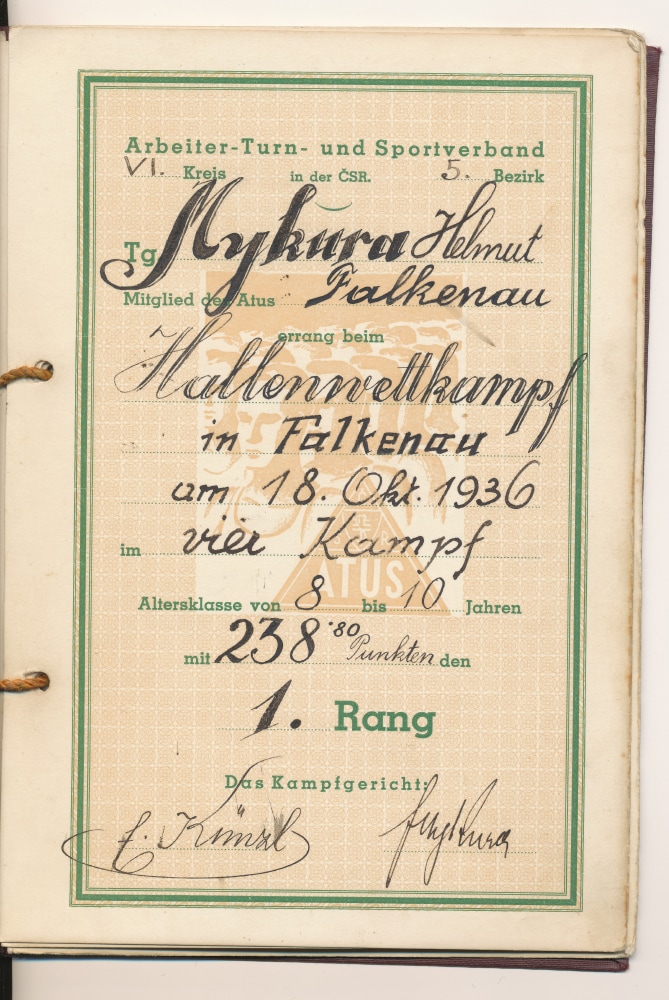
The Arbeiter Turn und Sportverband (ATUS) Workers’ Gymnastics and Sports Association, for which Franz Mykura worked as organizer, organised events for school children. This certificate in nine year old Helmut Mykura’s child’s ATUS certificate book shows one event. It was a multi-sport (vier Kampf -four competitions) indoor event for eight to ten year olds in Falkenau (now Sokolov). Other certificates in the book show a range of events, including skiing. The children are members (Mitglied) of ATUS and the regional organization is shown. Falkenau was in the V1 Kreis (sixth Region) and the 5 Bezirk (Fifth District.) The certificate from 1936 has two signatures. One of these signatures of competition judge (Kampfgericht) was Helmut’s father Franz Mykura the local ATUS organiser.
Mykura children’s toys in 1930s Czechoslovakia
Since babyhood with a rattle in hand, the brothers Walter and Helmut had excellent toys.
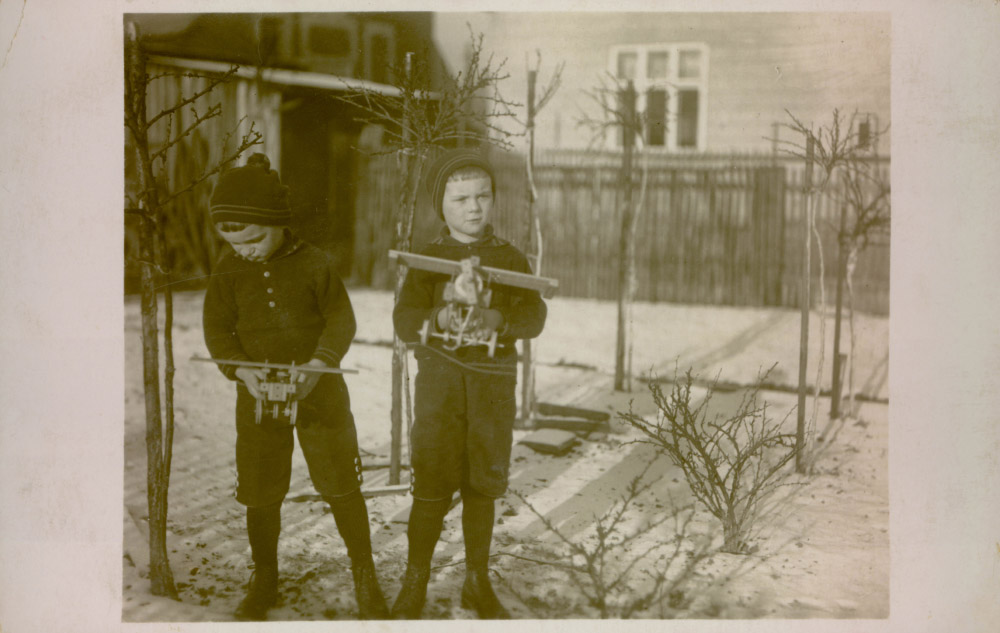
The toddler children played outside with a pile of sand and a variety of implements. Walter had a wooden dog on wheels pulled by a string. Each boy had his own child-size wheelbarrow and child-sized gardening implements. Each boy had a home-made Easter decoration on a plate representing eggs on grass. By the 1930’s each boy Helmut (left) and Walter (right) had an aeroplane model.
Mykura child’s savings bank book in 1930 Czechoslovakia
October 31st 1938 ‘Conversion to Reichsmark.’ ‘Umgerechnet auf Reichsmark’ is stamped in red.
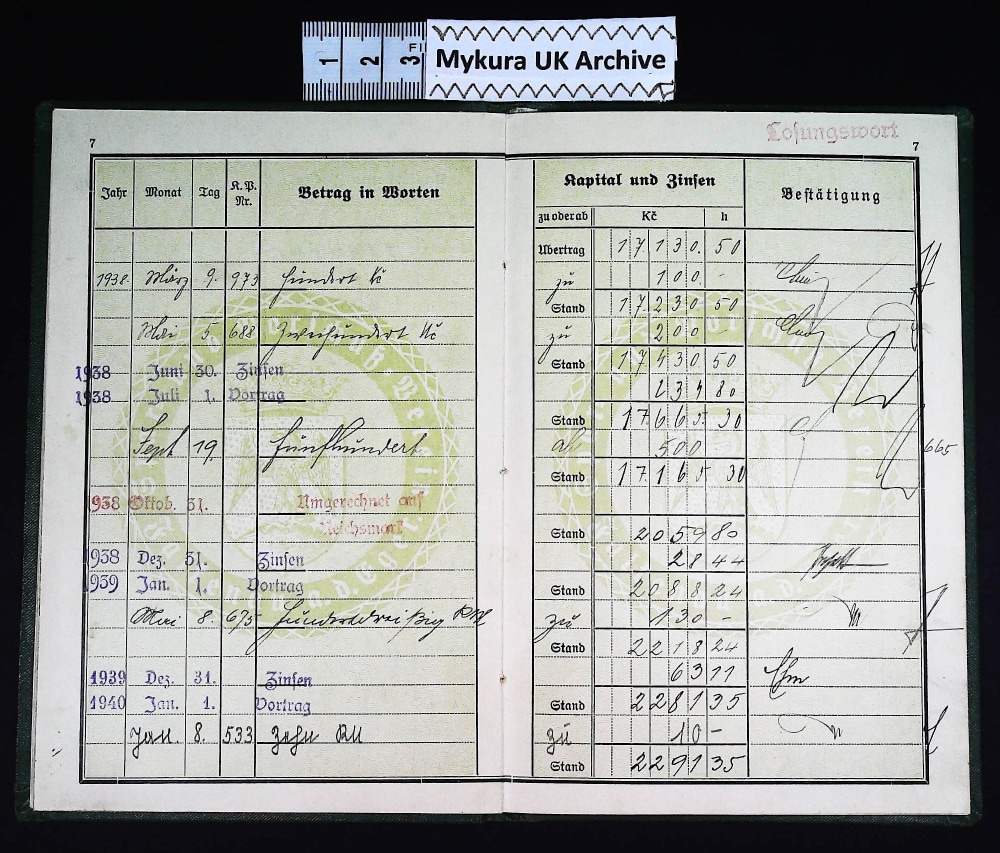
With this speedy conversion to Reichsmark, the currency had changed from Czech crowns to (Nazi) Reichsmarks. About 17,000 Czech crowns already saved was converted to about 2,000 Reichsmark. This currency conversion was one month after Hitler entered Czechoslovakia following the Munich Agreement of 30th September 1938.
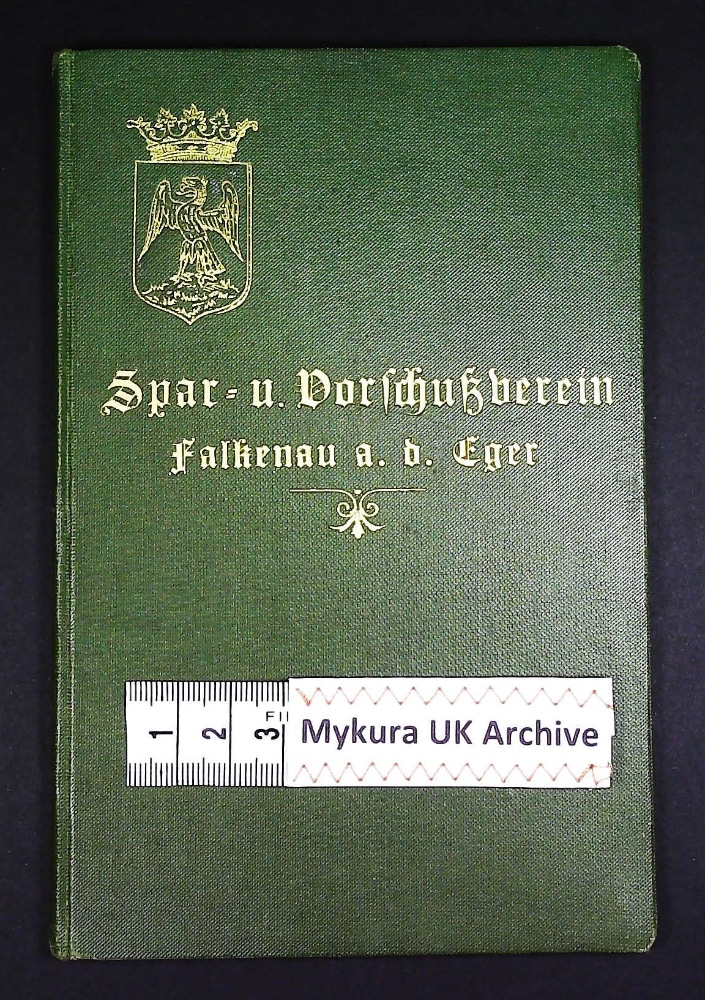
The savings book is titled Spar und Vorschuss Vereines (Savings and Loan Society) Falkenau a. Eger (Falkenau on the river Eger) in the name of eleven year old Helmut Mykura, address Lobsweg 28. The pages have a watermark Falkenau a. d. Eger. (Falkenau on the river Eger.) The account was open from 1935 when Helmut was eight years old. Deposits go from March 1935 to Jan 1940. Someone must have carried on the account, even paying in on one occasion during the war, after the Mykura family left. This savings book appears to have been left behind when the family fled the country in 1938. There were no withdrawals in this time. After 1941 there were no deposits and the sum was carried forward. Total saved: 2,532 Reichsmark. We know that Franziska’s elderly mother who left her home in Falkeanu in early October 1938, had to return home. She died later in 1942.
1930s social-democrat women work for a new, liberated motherhood
‘Frieden, Freiheit und Sozialismus’ (Peace, Freedom and Socialism.) ‘Kampf für eine neue, befreite Mutterschaft’ (struggle for a new, liberated motherhood.)
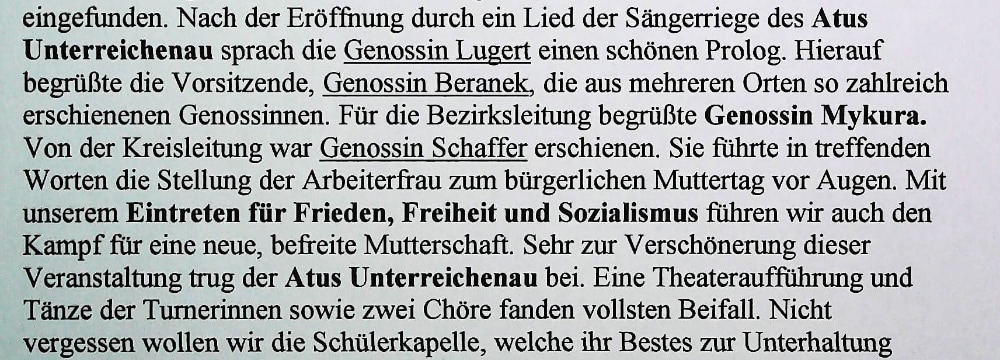
Franziska Mykura joins women working for peace, freedom and socialism in Czechoslovakia at a community event in the 1930s. Thank you to Sokolov Museum in the Czech Republic for these extracts from the Czech German-language social-democrat newspaper‚ Volkswille, naming Franz and Franziska Mykura and their work with the workers‘ sports organisation A.T.U.S.
Franziska Mykura welcomed 250 women at an afternoon meeting and stage show combining culture and politics, run by the Workers Gymnastics and Sports Club ATUS (Arbeiter Turn und Sportverband) as described by the local social-democrat German-language newspaper ,Volkswille.
Volkswille, Wednesday 13.05.1936 Our Working Women’s Meeting
Translation
On Sunday 10th May a further women’s afternoon meeting took place at Dengls Guest House in Unterreichenau. 250 female comrades gathered and the large room was full. After opening with a song from the Unterreichenau ATUS singers, Comrade (female) Lugert introduced the programme. The chairperson, Comrade (female) Beranek greeted numerous comrades from other places.
The District leader, Comrade (female) Mykura brought greetings from the District. Comrade (female) Schaffer, the area leader, aptly described the situation of of working women, whose civil responsibilites were obvious. By joining others in working for peace, freedom and socialism, we would also be striving for a new, liberated motherhood.
A theatre performance by ATUS Unterreichenau was an inspiration. The performance, the dance by female gymnasts and the two choirs was followed by loud applause. And we must not forget the schoolchildren’s fine effort in the programme (Die Schulerkapelle.) We hope that the wide -ranging presentation, so well prepared by the Unterreichenau comrades (female) inspires us and spurs us on to effective action.
Note from Mykura UK Archive: Unterreichenau (Dolni Rychnov) was a small mining town (pop 3000) 12km south of Sokolov
German text:
Volkswille, Mittwoch 13.05.1936
Ein Treffen unserer Arbeiterfrauen.
Our Working women’s meeting
Wie beliebt unsere Frauennachmittage sind, sah man wieder einmal bei unserem Treffen, welchen Sonntag, den 10. Mai, in Dengls Gasthaus in Unterreichenau stattfand. Der große Saal war vollständig besetzt, an 250 Genossinnen hatten sich eingefunden. Nach der Eröffnung durch ein Lied der Sängerriege des Atus Unterreichenau sprach die Genossin Lugert einen schönen Prolog. Hierauf begrüßte die Vorsitzende, Genossin Beranek, die aus mehreren Orten so zahlreich erschienenen Genossinnen. Für die Bezirksleitung begrüßte Genossin Mykura. Von der Kreisleitung war Genossin Schaffer erschienen. Sie führte in treffenden Worten die Stellung der Arbeiterfrau zum bürgerlichen Muttertag vor Augen. Mit unserem Eintreten für Frieden, Freiheit und Sozialismus führen wir auch den Kampf für eine neue, befreite Mutterschaft. Sehr zur Verschönerung dieser Veranstaltung trug der Atus Unterreichenau bei. Eine Theateraufführung und Tänze der Turnerinnen sowie zwei Chöre fanden vollsten Beifall. Nicht vergessen wollen wir die Schülerkapelle, welche ihr Bestes zur Unterhaltung beitrug. Wir hoffen, dass dieser von den Reichenauer Genossinnen so umsichtig vorbereitete Nachmittag auch für die weitere Werbetätigkeit anspornend wirken wird.
1930s Workers‘ Football Conference
Thank you to Sokolov Museum in the Czech Republic for these extracts from the Czech German-language social-democrat newspaper‚ Volkswille, naming Franz and Franziska Mykura and their work with ATUS
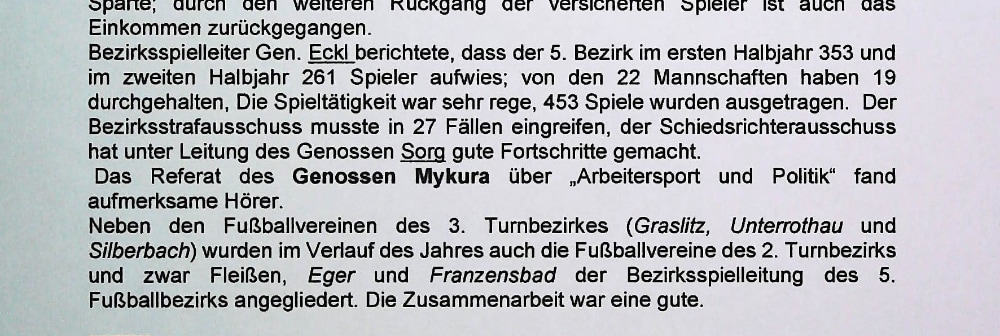
The five football leagues run by the local district branch of the Workers‘ Gymnastics and Sorts Club ATUS (Arbeiter Turn und Sport Verband) held a planning conference, which included the Referees Annual Conference.
Comrade Mykura’s report Workers‘ Sport and Politics had an attentive audience.
Translation
Volkswille, Thursday 19.01.1937
An excellent Football Conference
Sunday’s district football conference for 5 football leagues was characterised by complete unanimity and re-election of the previous district committee. There was serious discussion about political sports.
The referees annual conference took place in the morning. 26 officials took part. The section treasurer Wilfert reported that 1700Kc had been spent to fund the section.
The district leader, comrade Eckl reported that in the first half of the year the 5 leagues had played 353 games and in the second half of the year had played 261 games. Out of the 22 teams, 19 had gone through. The Referees Comittee had done well under Comrade Sorg.
Comrade Mykura’s report ‘Workers’ Sport and Politics’ had an attentive audience.
The football clubs in three other districts, Graslitz, Unterrothau and Silberbach would in the course of the year be divided into groups, followed by two districts, Eger and Franzensbad.
Cooperation was good.
German text:
Volkswille, Dienstag 19.01.1937
Eine schöne Fußballertagung.
An excellent Football Conference
Die Kennzeichnung der sonntägigen Bezirks-Fußballerkonferenz des 5. Fußballbezirks in Chodau waren vor allem vollste Einmütigkeit, die ernste sportpolitische Diskussion und einstimmige Wiederwahl der bisherigen Bezirksspielleitung. Bereits am Vormittag hatten sich die Schiedsrichter zur Schiedsrichterjahresversammlung eingefunden. Von den 32 im Stande befindlichen Schiedsrichtern haben 26 die Funktion ausgeführt und an den Tagungen teilgenommen. Der Spartenkassier Wilfert berichtete über 1700 Kc Ausgaben für die Sparte; durch den weiteren Rückgang der versicherten Spieler ist auch das Einkommen zurückgegangen.
Bezirksspielleiter Gen. Eckl berichtete, dass der 5. Bezirk im ersten Halbjahr 353 und im zweiten Halbjahr 261 Spieler aufwies; von den 22 Mannschaften haben 19 durchgehalten, Die Spieltätigkeit war sehr rege, 453 Spiele wurden ausgetragen. Der Bezirksstrafausschuss musste in 27 Fällen eingreifen, der Schiedsrichterausschuss hat unter Leitung des Genossen Sorg gute Fortschritte gemacht.
Das Referat des Genossen Mykura über „Arbeitersport und Politik“ fand aufmerksame Hörer.
Neben den Fußballvereinen des 3. Turnbezirkes (Graslitz, Unterrothau und Silberbach) wurden im Verlauf des Jahres auch die Fußballvereine des 2. Turnbezirks und zwar Fleißen, Eger und Franzensbad der Bezirksspielleitung des 5. Fußballbezirks angegliedert. Die Zusammenarbeit war eine gute.
See more newspaper reports about workers‘ sports in the 1930’s in Key Documents Three.
See Link to more newspaper reports about workers‘ sports in the 1930’s in Key Documents Four.
Franz Mykura and the 1937 Workers’ Winter Olympics
On behalf of the workers’ sports organization, ATUS, Franz Mykura led the committee that organized this international event
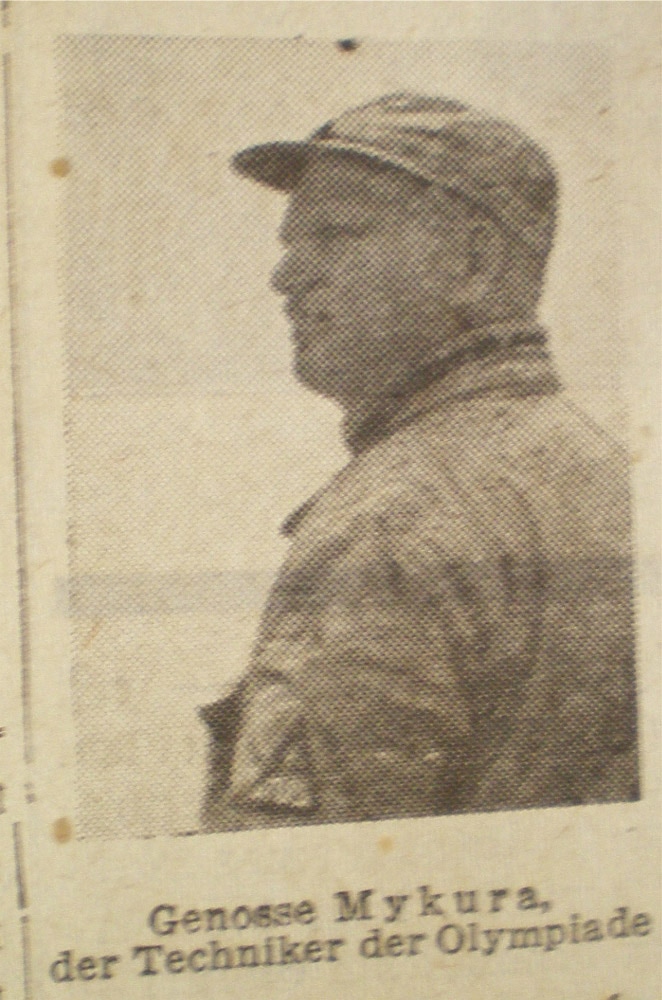
Genosse (comrade) Mykura der Techniker der Olympiade’ in a photo of 18th February 1937. He has an ATUS badge on his sleeve. The international event Arbeiter Olympiade Winter 1937 was held in February in Johannisbad, (now Janské Lázně) in Czechoslovakia before the main summer Workers’ Olympic event later in 1937 in Antwerp.
This was the last in a series, of workers’ Olympiads, supported by social-democrats and trades unions, because World War Two led to the next 1943 Helsinki event being cancelled. Franz Mykura led the organizing committee that prepared and ran the Johannesbad (now Janské Lázně) winter event. He presented the prizes.
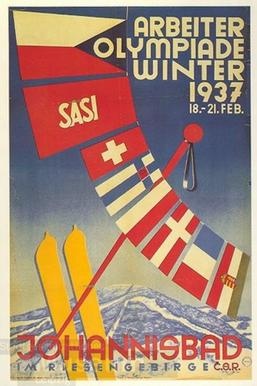
The brilliant design of the 1937 Workers’ Winter Olympics poster has the red, white and blue flag of Czechoslovakia at the top making the point of social-democrat allegiance to the state, with the red SASI flag below, followed by flags of participating countries.
SASI was Sozialistische Arbeitersport Internationale or Socialist Workers’ Sport International, with its secretariat in Prague. In 1935 SASI had announced ‘Athletes and Gymnasts of the world to boycott the Hitler Olympics.’ The Chairman of SASI was the Austrian social-democrat Dr Julius Deutsch, who had found time in the year of the 1934 Austrian crisis to attend an unusual, small workers’ sport event at Dorchester, England, to celebrate the centenary of the trade unionists the Tolpuddle Martyrs.
The bottom half of the 1937 poster dramatically raises bright skis, crossed diagonally by the bright red ski pole. In the distance the famous Schwarzenberg (Cerna Hora) mountain with its prominent ski runs and ski-lift invites the guests to take part in magnificent winter sport. SASI collapsed at the start of World War Two. The initials CSR in the bottom right of the poster are the initials of the First Czech Republic that lasted till 1938. The Second Czech Republic lasted a short time after the Munich Agreement in 1938 until the Nazis took over the government in Prague in March 1939. Franz Mykura’s participation in SASI is mentioned in his obituary. See link to obituary in 1960s section of website.
Franz Mykura: two publications of the 1930s.
1. A booklet by Franz Mykura is in the archive of the German social-democrat foundation, the Friedrich Ebert Stiftung. (FES)
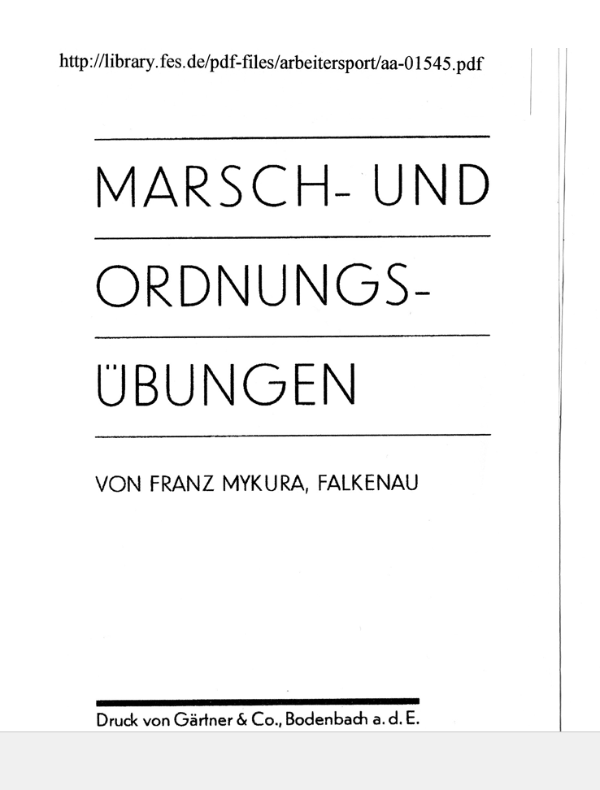
‘Marsch und Ordnungs Ubungen’ (Practical Formation Exercises) is an undated booklet by Franz Mykura, printed by Gärtner & Co in Czechoslovakia at Bodenbach an der Eger (Bodenbach on the river Eger). It promotes sport as a way of countering the factory workers’ lassitude arising from lack of light, air and nutritious food whilst living in wretched housing. Basic formation exercises are described, followed by the range of sports from gymnastics, athletics, Jiu-Jitsu, boxing, wrestling, walking, scouting games, swimming and skiing.
2. Franz Mykura wrote a chapter on the Sports Proposal in this 1930 publication by Franz Grasse ‘Civil Defence Training Course in the ATUS Association.’
This year long training course booklet is in the archive of the German social-democrat foundation, the Friedrich Ebert Stiftung. (FES)

‘Lehrgang für Wehrerziehung in der Atus-Union’ by Franz Grasse 1930
(Lehrgang – course, Wehr – defence, Erziehung -education
A -Arbeiter (workers), T – Turn (gymnastics), U – und (and),
S – Sportsverband (sports club), Union – (Association)
This document of 1930 shows ATUS developing civil defence ideas. The German-speaking social-democrats in Czechoslovakia worked with their sports organisation to develop civil defence in the community to defend the Czechoslovak republic against Nazi inspired violence. In the anti-Nazi DSAP, ‘Der Deutschen Sozialdemokratischen Arbeiterpartei in der Tschechoslowakei,‘ (The German Social Democratic Workers‘ Party of Czechoslovakia‘) to which Franz and Franziska Mykura belonged, this civil defence organisation was called called ‘Republikanisches Wehr R.W.’ (Republican Defence.) Franz Mykura was a member of R.W. Nazi violence increased in 1938 until the crisis of the Munich agreement led to the collapse of the state of Czechoslovakia and a greater movement of refugees, which included the Mykura family leaving Falkenau.
1939 A Prague insurance company chased missed payments.
After Franz Mykura became a refugee his personal insurance instalments were unpaid.

A letter from an insurance company in Prague to Franz at his home address in Falkenau ( now Sokolov) dated 12th June 1939 tells him that his life insurance payments are not up to date. Franz had left Czechoslovakia in October 1938.