
The Mykura family flee Falkenau (now Sokolov) in late September 1938
Key Document One in the Mykura UK Family Archive is ‘WHEN I WAS LIVING IN A SMALL CZECH VILLAGE’ by Franziska Mykura (1905-1966) written later in the UK, in an undated typed document on four small sheets of papers signed in red on top right.

‘WHEN I WAS LIVING IN A SMALL CZECH VILLAGE’
Commentary
A closer look at twenty-four words or phrases used in the source document.
- In the title to this document, ‘WHEN’ refers to the time before Franziska Mykura left Prague on 1 December 1938 for the refugee rail journey to Gdansk in Poland, with her two sons Walter and Helmut, aged twelve and eleven.
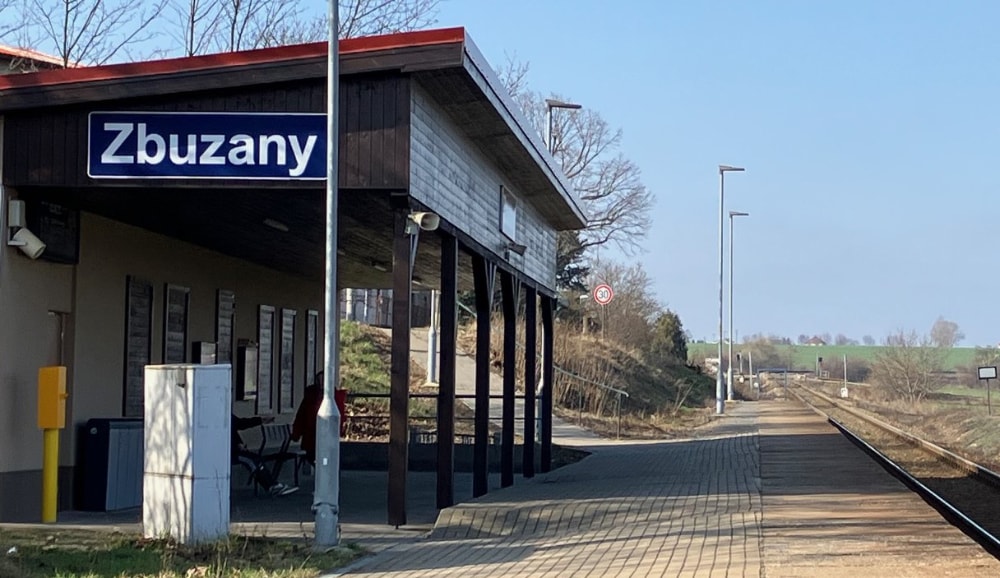
- The ‘small Czech village’ in the title means it was a largely Czech-speaking village, in contrast to their home town in the Sudetenland, where the German-speaking Mykura family had lived until the Munich crisis. The Czech village was Zbuzany near Prague. It was not part of the Sudetenland, from where the family escaped. The Mykura family chose Zbuzany as their first stopping point as refugees on leaving their home town. Franz Mykura arrived in the UK on 31 October 1938, before the rest of his family, so he would have spent less time in the ‘small Czech village’. The name of the village was not identified in Franziska Mykura’s document. The Mykura Archive discovered the name in 2022 on reading UK National Archive document HO 294/490/237. It reports that he (Franziska’s husband, Franz Mykura on May 8th 1941) ‘produced a certificate from the Town Council at Zbuzany, dated 11.2.39, in which it is stated that the Mykura Family lived at Zubzany No.74 from 22.8.1938 until 30.11.1938.’ This August 1938 date of arrival in Zbuzany does not correspond with Franziska’s September 1938 description in her document (See Commentary numbers 3, 10, 12.)
- The last days of September 1938’, is the first sentence of the document, referring to the Mykura family leaving their home. (See number 2 for a conflicting date.)
- ‘We the Anti-Nazis’, refers to the anti-Nazi political party to which Franz and Franziska belonged and for which they worked. Franziska did not name the party. It was the DSAP (Der Deutschen Sozialdemokratischen Arbeiterpartei in der Tschechoslowakei – The German Social Democratic Workers‘ Party of Czechoslovakia). The word ‘German’ in this context means Czech citizens who were part of the long-established, large, German-speaking minority in Czechoslovakia.
- ‘The small town where I was living’ is unnamed. It was Falkenau (renamed Sokolov after the Second World War). The family fled because it was near to the German border where Hitler would enter to rule the Sudetenland. Hitler entered Falkenau on 4 October 1938.
- ‘The majority favoured the “Anschluss”’, refers to the annexation (Anschluss) of the Sudetenland by Nazi Germany, which was the Munich Agreement. The majority of the Czech citizens who made up the German-speaking population in Falkenau supported this idea. In contrast, the minority social democrat and communist political parties opposed the Nazi takeover in the Sudetenland.
- ‘…fled in masses over the border’, refers to Czech Nazi supporters crossing the German border in order to leave the Czech Sudetenland. On 15 September, Konrad Henlein, the leader of a pro-Nazi Party in Czechosovakia, had moved into Germany. He called on his supporters to find freedom, peace and work by going to Germany.
- ‘…war’ or ‘Hitler takes over’, refers to the growing Munich crisis, which had left only these two options available to Czechoslovakia.
- ‘Sudetenland’ was the word used in the twentieth century to name the area of Czech land along the German border where the German-speaking Czech population was concentrated. This area was given to Hitler by the Munich Agreement on 3 September 1938. Hitler and his soldiers entered the Sudetenland on 1 October 1938.

- ‘The general evacuation, which our party organized for their members.’ In a time of escalating violence, the DSAP was proactive in helping its members flee at short notice. It is likely that the DSAP chose a date when they decided politically all was lost, but hopefully a date before their members and families were further threatened, attacked or imprisoned. Franziska wrote that this was in the last days of September. (See number 2 for a different date.)
The crisis built during September 1938. Hitler’s propaganda speech against the Czechs at the Nuremberg Rally on 12 September 1938 provoked clashes from Nazi supporters in Czech border towns, including Falkenau. Chamberlain made the first of three visits to Hitler on 15 September in Berchtesgaden. Anglo-French talks in London on 18 October threatened Czechoslovakia with loss of the Sudetenland. The Czech government rejected the Anglo-French plan on 20 September. The Anglo-French ultimatum on 21 September 1938 forced the devastated Czech government to accept giving Hitler the Sudetenland without a fight. On the 22 September, the Czech government of Milan Hodža resigned. Huge demonstrations continued and Chamberlain visited Hitler for the second time in Godesberg. This time, Chamberlain received an escalated demand from Hitler that the Sudetenland be handed over on 1 October 1938. - ‘…a Czech boy’ in this context is likely to refer to the language (not the nationality) of the boy from Zbuzany, where twelve-year-old Walter Mykura had earlier stayed on an exchange with ‘a Czech boy’. Doing such a language/cultural exchange between children shows the social democrat commitment to good community relations.
- ‘Czech soldiers were patrolling the streets, they let us pass,’ wrote Franziska describing leaving with hurriedly packed suitcases and a roll of blankets. This matches the late September date given by Franziska. (See number 2 for a conflicting date.) Martial law was imposed on 14 September 1938 by the Czech government in response to the Hitler threat. The Czech army was mobilised on 23 September 1938.
- ‘…an inspired communist’ is likely to refer to a helpful member of the Czech Communist Party who was also under threat from Hitler. The communists and the social democrats were the only two political parties in Czechoslovakia that opposed Nazism.
- ‘Then came the mobilisation’, refers to the Czech government calling up the Czech army. Czech troops were deployed to the disputed Czech border on 23 September 1938.
- ‘…trusted the pact’, refers to the importance for Czechoslovakia, as a small country threatened by Germany’s dictator, of being able to trust its international agreements from larger supportive countries. This loss of trust in the UK and France, when faced with threat of invasion by the Nazis, was devastating.
- ‘The biggest demonstration Prag had ever seen’, refers to a wave of demonstrations and strikes on 22 to 23 September 1938 against the enforced loss of the Sudetenland.
- ‘A new president was nominated, a man unknown to the nation’, refers to new President Hácha, who was a conservative lawyer not involved in Czech government – unlike President Beneš, who had been well known in Czech governments since 1918.
- The ‘new border separated the country’. This was the border between Nazi-occupied Sudetenland, which was now part of Germany, and the still-unoccupied interior of Czechoslovakia with its capital in Prague. The Munich Agreement did not give the interior of Czechoslovakia to Hitler. He took it regardless, six months later, when the German army marched into Prague on 15 March 1939.
- ‘Jewish Synagogues were burnt down.’ This refers to the widespread anti-Jewish November Pogrom called ‘Kristallnacht’, which took place on 10 November 1938 in parts of Germany, Austria and the border regions of Czechoslovakia. This was about six weeks after the Munich Agreement. During the Pogrom, the synagogues at Falkenau (now Sokolov) and Karlsbad (now Karlovy Vary) were both burnt down, while other synagogues in Czechoslovakia were destroyed or damaged. Camps were quickly created for refugees in Czechoslovakia. After the Munich Agreement, the situation of Jewish residents and refugees in the Sudetenland, as well as in other parts of Czechoslovakia, was more desperate. Many Jews were imprisoned in camps. Unknown numbers of Jews were sent to concentration camps.
- ‘Our friends were put in to concentration camps.’ One example is Czech social democrat friend Alois Ullmann, who Franz Mykura had worked with in 1924 at the Karlsbad 1924 Turnfest (Karlsbad 1924 Gymnastics Festival). Alois Ullmann survived Dachau concentration camp during World War Two, and went on to live in Germany, while his wife Frau Emma Ullman lived at the same address in Birmingham as the Mykura family in the 1950s. Refugees in Czechoslovakia were put into Czech camps in the winter of 1938-39, before the Nazis took Prague in March 1939. Falkenau, where the Mykuras had lived, was the site of a much later, smaller camp from 1944, until it was liberated and filmed by American soldiers in 1945. This later Falkenau camp is described in the Sokolov (formerly Falkenau) Museum.

- ‘…members of our “Home Guard” were sent to prison’, refers to the social democrat, political defence group, Republikanischen Wehr (Republican Defence, or RW) to which Franz Mykura belonged. Franz Mykura had contributed to the1930 booklet, Lehrgang für Wehrerziehung in der Atus-Union (Course on defence education in the ATUS association). See: https://library.fes.de/pdf-files//arbeitersport/aa-01544.pdf
RW was intended to protect public meetings and party actions, but also to defend democracy and the republic in Czechoslovakia. There was an RW group in Falkenau (now Sokolov) where Franz and Franziska Mykura lived until 1938. - ‘The interpreter’ was son Walter, aged twelve, who must have known more Czech than his German-speaking mother Franziska. Walter had learned Czech at school and had been on an exchange with a Czech-speaking boy.
- ‘…politically everything looked very bleak.’ Living in Zbuzany in October and November 1938, Franziska would have been all too aware that the German invasion of the Sudetenland and the collapse of the Czech government meant the end of democracy. Authoritarianism grew in the Second Czecho-Slovak Republic (6 October 1938 to 13 March 1939). The number of vulnerable refugees in Prague was growing. Civilians’ civil rights were lost. Britain and France, as European powers, had forced Czechoslovakia into the economic loss of its most highly industrialized territory in the Sudetenland. Germany had gained Czecholovakia’s arms factories, border forts, coal mines, chemical and other industries. The November Pogrom (see point 19 above) had happened less than three weeks before Franziska and her sons escaped via the Polish route.
- ‘My old mother, she had to go to our home town back. I never did see her again.’ This refers to the sad abandonment of Frau Schmiedl, the mother of Franziska Mykura, and the grandmother of the two Mykura boys, Walter and Helmut. Franziska and Franz Mykura had bought Frau Schmiedl’s property in Falkenau – with a formal arrangement that Frau Schmiedl, was to remain living with them in the property, with practical and financial support from Franz and Franziska until her death. This was stated as Frau Schmiedl’s ‘sole right of occupation together with free heating and light of the gabel [sic] room of the house’, ‘appropriate and wholesome board at the communal table, or if she so desires in the above mentioned gable room, to give her clothing in accordance to her standing and to pay her weekly pocket money of thirty crowns and to pay all expenses incurred through illness and all funeral arrangements’. This agreement worked until 1938. Seven years later, after World War Two, Franziska found out that her mother had died in 1942, ‘after four very lonely years’.
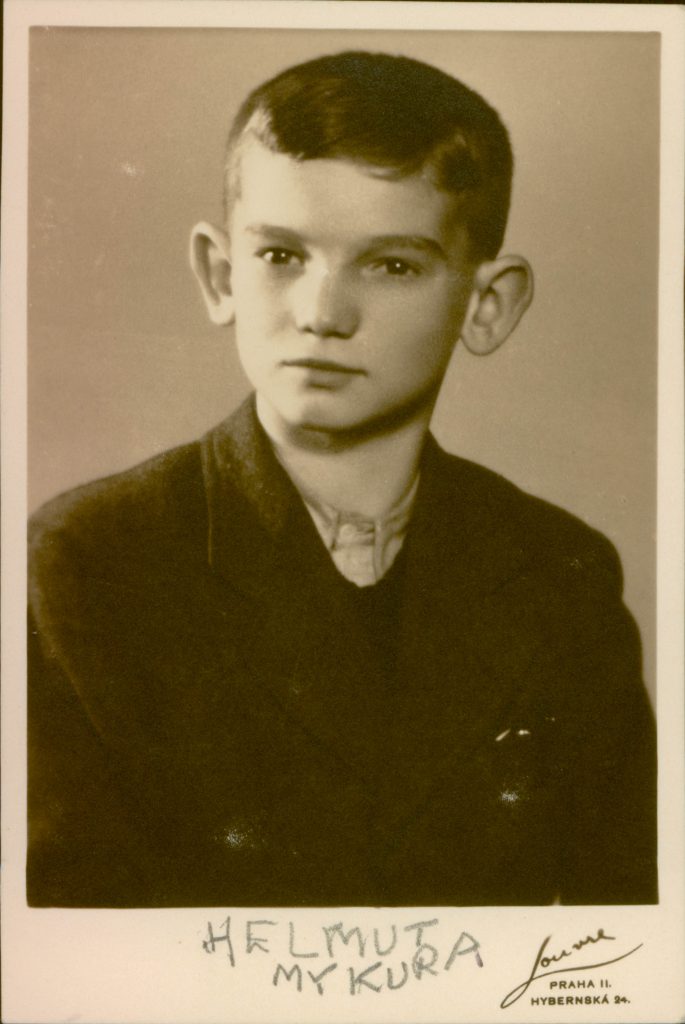
There is one photo from this period with a Prague connection, of Helmut Mykura in 1938, aged eleven, with the address of the Prague photographer on the front.
‘My Journey from Czechoslovakia to England’ by Walter Mykura
Key Document Two in the Mykura UK archive

Walter wrote:
“Many Democrats and Jews, who feared to be put into concentration camps, came into the undefended centres of those countries. There were at least 60,000 refugees in Prague and its environs. On December 1st the day for us to leave our native country had come. Our express train rushed eastwards. First we were very excited and nobody thought of sleeping. We boys ran round the carriages and made friends with other children who travelled with us.”
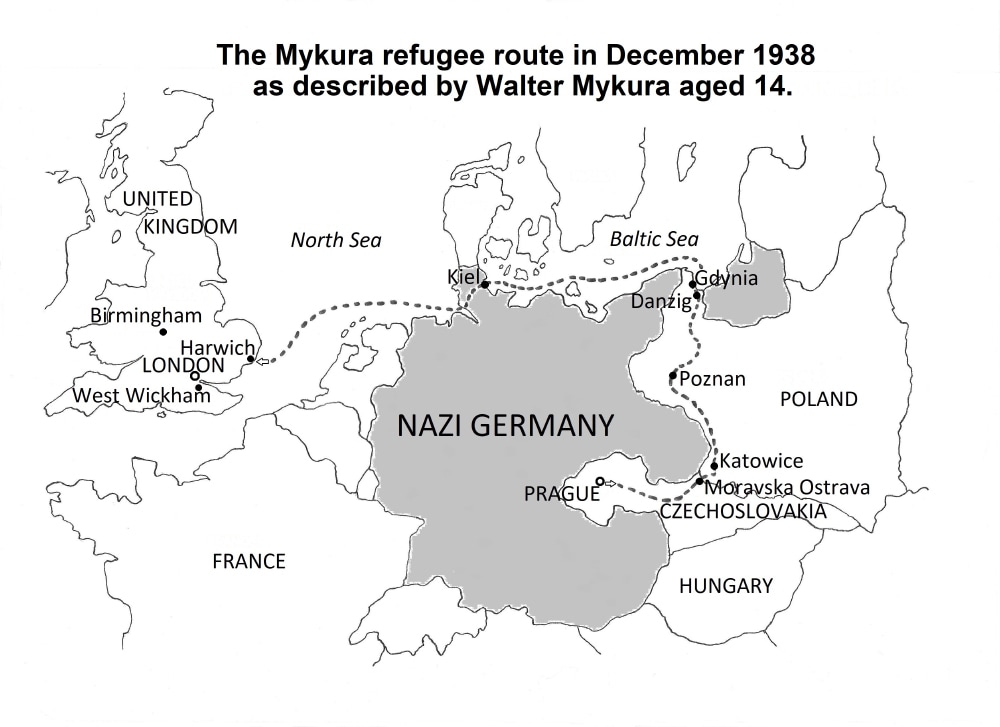
Twelve year old Walter travelled with his mother and brother on the 1st December 1938 from Prague to Danzig by train then by the ship named ‘Warszawa’ to the UK, arriving on 6th December 1938. His father had travelled earlier to the UK arriving on 31st October 1938. At school in Birmingham, UK, Walter Mykura aged 14 years wrote an article in his school magazine, The Yardleian, July 1940 about his journey eighteen months earlier,
Franz Mykura arrived in the UK on 31st October 1938
Franz “landed at London on 31st October, 1938 with a Czech passport NO: 387 issued at Falknov on 14th June, 1928, and renewed on 26th December 1937. “
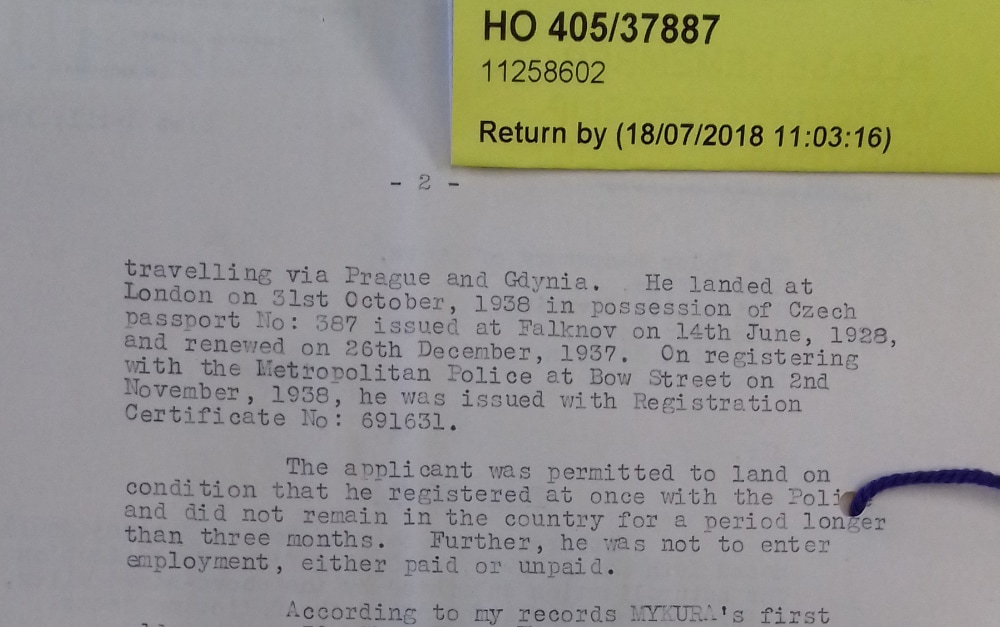
The UK National Archive file reveals Franz’s arrival date. Franz “was permitted to land on condition that he registered at once with the police and did not remain in the country for longer than three months. Further he was not to enter employment, either paid or unpaid.” Franz arrived in the UK five weeks before his wife and children and they were reunited in Birmingham, UK about six months later.
Franziska arrived in the UK on the 6th December 1938
Arriving in the UK with her two sons, but without her husband who had arrived before her, Franziska was refused permission to work, paid or unpaid.

Franziska Mykura was a wife, so her UK government-held information was added to her husband’s file. Her first name was on the front of the file under Franz Mykura’s name – wife: Franziska. She did not have her own file. Eleven months after arriving in the UK Franziska “was permitted to accept domestic employment.”
Mrs Mykura landed “at Harwich in possession of Certificate of Identity No 1840 issued in Prague on 5thNovember, 1938. She was permitted to land on condition that she did not remain in the UK longer than one month, and did not enter employment paid or unpaid.” “On reporting to the police at Bow Street on 20thDecember, 1938, she was issued with Registration Certificate No: 698326.”
The UK National Archive doc HO 294/490/237 in the name of Franz Mykura reveals more. The Mykura family left Falkenau their home town on the 22nd September. This was a week before the Munich Agreement. The Family lived at the village of Zbuzany No 74 from 22/8/1938 to 30/11/38 when Franziska Mykura travelled from Prague to Poland with her sons to get the ship to Harwich. Franz Mykura, who travelled before the rest of his family, had permission to cross the Czech border on the 22nd October 1938. He left the Czech republic on 23/10/38 for the UK via Poland.
The UK National Archive doc HO 294/490/237 reveals that in 1939 before World War Two Franz in the UK was listed as receiving financial help. The refugees were not allowed to work. The list of monies includes a variety of costs eg shoe repairs at £1-5-6. (One pound five shillings and six pence.) By June 1939 Hythe was mentioned and in August 1939 the fare of 17/8 (seventeen shillings and eight pence) from Hythe to Birmingham is named, going to Colibrook Road, Shirley, Birmingham. This is probably the date the family was re-united, living together after ten months separation. Some items for Mrs Mykura are included eg dental costs paid to Dr Woods in Hythe. In wartime from Sep 1939 the family got 15/- (fifteen shillings) a week. The biggest payments on behalf of the family were in November 1939 “£3.3.0 to Queen Victoria Hospital for treatment in April.” The location of this hospital is not known. On the same date “£21.3.3. has been paid to Kent Count Council on Oct 17 for isolation hospital in April.” The location of the isolation hospital is not known, nor which family member was in hospital. Other payments included £8 for the term to Yardley Grammar School in Birmingham for the two Mykura boys.
HO 294/490/237A in the name of Franziska Mykura says Franz Mykura was already living in Dollarbeg, near Stirling Scotland when Franziska arrived in the UK on 6th Dec 1938.
Did Doreen Warriner and David Rhys Grenfell M.P. help Franz Mykura make his refugee journey?

Thank you to the London Metropolitan Archive for sight of the itinerary from United Baltic Corporation which was the shipping company running a regular service to Baltic ports. Franz Mykura arrived in London on the Baltrover on 31st October 1938, which is the last October arrival listed (bottom right) in the itinerary above.
Oral family history speaks of ‘a Labour MP on the boat helping to keep them safe.’ The UK National Archive files HO 294/490/237 and HO 294/490/237A, described above, confirms that the dates of Franz’s journey match David Rhys Grenfell MP train transport. Grenfell’s diary of 17th October 1938 had noted the cost of Baltrover tickets as ‘3rd class £5-10-0.’ Both Warriner and Grenfell were in Prague in late October 1938 trying to help refugees. Grenfell put the refugees on board the British ship Baltrover in Gdynia, Poland.
Who was Doreen Warriner? (1904-1972) She had been an academic researcher in Czechoslovakia in the 1930’s. She travelled to Prague on 13th October 1938 as a concerned individual with experience, knowledge and connexions, becoming a representative in Prague for the ‘British Committee for Refugees in Czechoslovakia.’ More famous for alerting Nicholas Winton in December 1938 to the needs of Prague’s refugee children, Doreen had in October 1938 worked in Prague with David Rhys Grenfell, a MP in the UK parliament.
Who was David Rhys Grenfell ? (1881-1968) D. R. Grenfell was a UK member of parliament (MP). He was a Welsh miner who left school aged twelve to work underground in a coal mine. He became a Labour Party member of parliament (MP) in 1922 and was interested in the international affairs, having visited Spain during the civil war with other United Kingdom MPs.
At this time before the war, UK refugee policy was delegating selection of names of some possible refugees to some voluntary bodies who were trying to help. Visas were required for these groups. Most refugees in Prague could not get visas. Most refugees in the UK were not allowed to take up employment and many depended on the refugee organisations for financial support.
How UK contacts such as Doreen Warriner (DW) and David Rhys Grenfell met in Prague after Wenzel Jaksch attended talks in London on October 5th1938.
The notes below are from the posthumously published 1984 article by Doreen Warriner ‘Winter In Prague.’ The Slavonic and East European Review (SEER) Vol 62, No 2, April 1984 pages 209-240. University College London, School of Slavonic and East European Studies.
Additional comments about Franz and Franziska Mykura have been added by the Mykura UK Family Archive
Notes: On 13 October 1938 D.W. flew to Prague. In the next two days she met Wenzel Jaksch the leader of the political party to which Franz and Franziska Mykura belonged, the DSAP. Der Deutschen Sozialdemokratischen Arbeiterpartei in der Tschechoslowakei, (The German Social Democratic Workers‘ Party of Czechoslovakia), HD Harrison from the UK newspaper ‘News Chronicle,’ William Gillies, the UK Labour Party International Secretary, and two UK Labour Party Member of Parliament, David Rhys Grenfell MP and George Hicks MP, John Troutbeck, who was First Secretary British Legation in Prague and Eric Crowe, British Legation in Prague. Warriner then met Siegfried Taub, Secretary and Vice President of the Sudeten German Social Democratic Party. At Taub’s office lists were drawn up of those who were most in danger.
Gillies had a plan for leaders of the Social Democratic Party. Gilles and Taub asked Warriner to stay and look after the transport of these refugees. Gilles and Grenfell returned to London to get visas. On the 16thOct 1938 Gillies and Grenfell met Lord Halifax, the Foreign Secretary of the UK government, who gave approval for 250 visas for Sudeten German Social Democrats on the Labour Party guarantee.
The first journeys of D. R. Grenfell and D. Warriner with social-democrat refugees from Sudetenland..
19th October 1938. Grenfell returned to Prague. Page 212 ‘Grenfell said we must get them out at once.’ Routes were discussed. Grenfell turned down the idea of a big refugee train as ‘too risky.’
Sat 23rd Oct 1938. (Note – an error here, Saturday was the 22nd October 1938.) Grenfell decided to go with 50 men and ‘find a way.’ Their route was unknown. They left Masaryk Station in Prague where the refugees said good-bye to their wives. ‘These men would be asked for by Hitler.’
Page 212 Grenfell rang from Poland after their 30 hour journey. Grenfell asked DW to bring the next lot the same way:
25th October 1938. DW’s group went on slow train to Slovakia, motor train past Orava castle, over a pass in the mountains to the frontier at Sucha Hora, waited one day with sun and snow on the Tatra, in a poor Slovak village where the inn could provide only eggs; at night a tiny train appeared on the Polish side, so they walked over the border, luggage was examined, slow train to Nowy Targ, missed connexion to Krakow, where Grenfell was waiting to meet DW and her group. DW’s group decide to wait for the midnight train to Krakow, While DW went on ahead in the express, and arrived at Krakow, where Grenfell pushed her on to the Express for Warsaw, giving her a plane ticket from Warsaw to Prague, saying, ‘Go back and get some more.’
27th Oct. DW back in Prague by midday.
Meanwhile, Grenfell took both groups on from Krakow to Gdynia (port of Gdansk) and ‘fixed their passages on a boat.’
Tessa Rowntree took the next two transport to Gdynia. News Chronicle’s Alec Dickson did two journeys and John Ingman of the Workers’ Travel Company was a regular courier.
30 Oct 1938. DW goes with Wenzel Jaksch to visit Sudeten German refugees in camps in a school (Nizkov), castles (Svetla and Doni Krupa), village halls. There were no blankets and a coal shortage.
31st October. Grenfell was back in Prague, then back to London. DW stayed in Prague to get British and Polish visas for the rest of the men on the list.
9th November 1938. The majority of men on the 250 list had gone. At this stage DW ‘had not realized the ‘real nature of the refugee problem.’
Walter Mykura aged 14 writes in his school magazine in Birmingham, UK in 1940 giving the dates of his journey from Prague to the UK with his mother and brother, who arrived separately from Franz Mykura in early December, 1938. Walter wrote that on December 1st 1938 they departed Wilsonovo Nadrazi Station Prague travelling by train via Moravska Ostrava, Katowice, Danzig, Gdynia, then by ship “Warsaw” through the Kiel canal arriving at Harwich, UK.
The Mykura brothers aged twelve and thirteen at school
They were welcomed at school in Birmingham UK in April 1939.

‘Three boys from Czecho-Slovakia joined the school in the Spring term. They are at present in form 2A. We wish them a happy time in this country, where already they have astonished us by their ability to adapt themselves to our language and regime.’
The three unnamed new boys were Lou Ullmann, Walter Mykura and Helmut Mykura. The school magazine ‘The Yardleian dated July 1939, states that the three boys arrived in the spring term. This was before the start of World War Two in September 1939.
Franz wants to stay in the UK in Spring 1939
Six German destroyers are in the English Channel, near the Czech refugee group in Hythe.
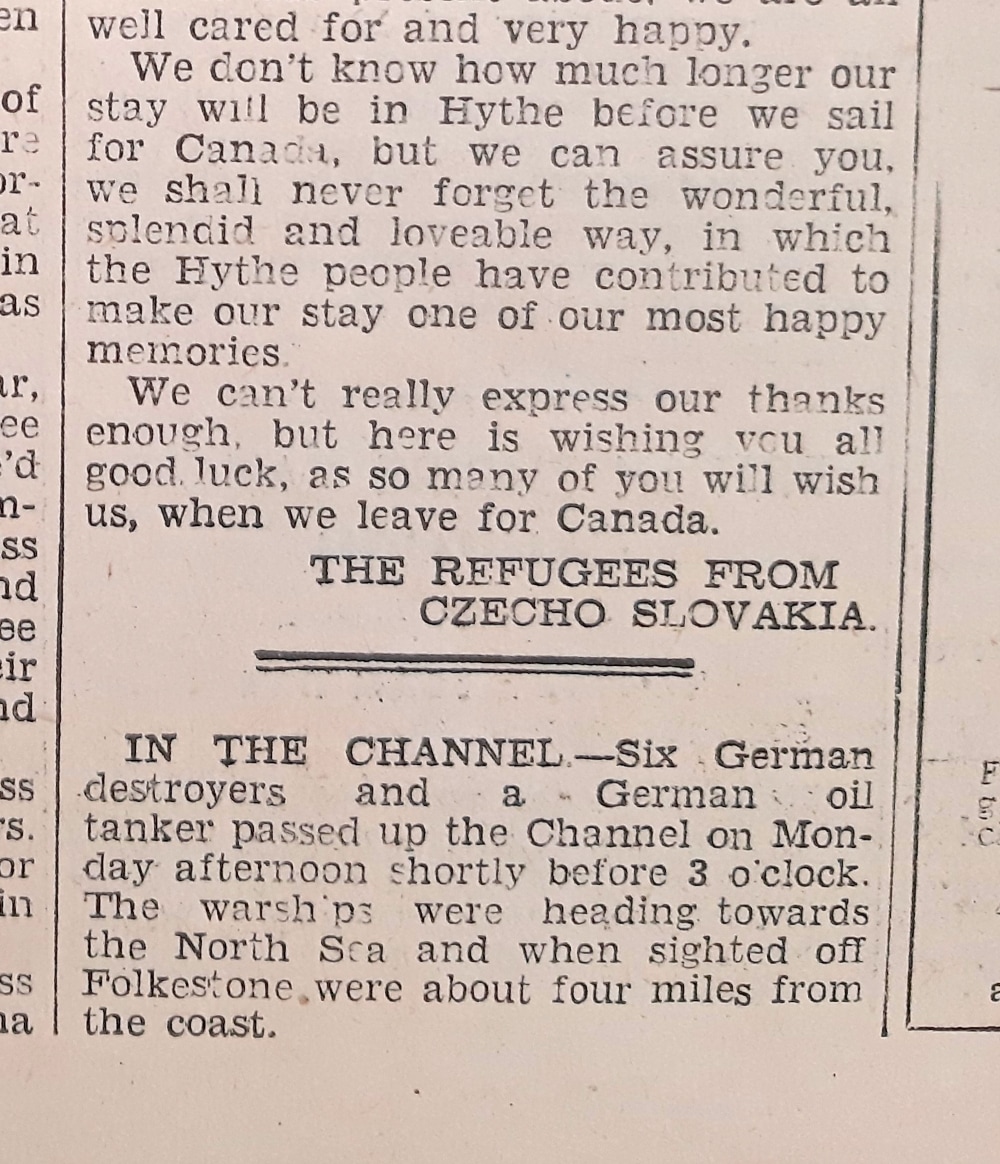
Franz Mykura was with a group of Czech refugees in spring 1939 in Hythe near Folkestone on the south coast of England. World War Two had not yet started, but German ships were only a few miles away. A small notebook from Hythe Laundry has Franz’s name and Hythe address on the front, written by Franz. The image is from an article in the Folkestone and Hythe Herald newspaper dated May 20th 1939, titled, ‘Refugees Say Thank-you.’
Franz Mykura had permission to stay in the UK for three months and the three months are up, while war gets closer. Franz is separated from his family after leaving Czechoslovakia without them. Franz’s wife and two sons Walter and Helmut are now in Birmingham. The sons are at school there. The 1939 dates of Franz arriving and leaving Hythe are not known.
Refugees’ feelings expressed in letter to newspaper
Leaving ‘a land of broken homes and much suffering.’
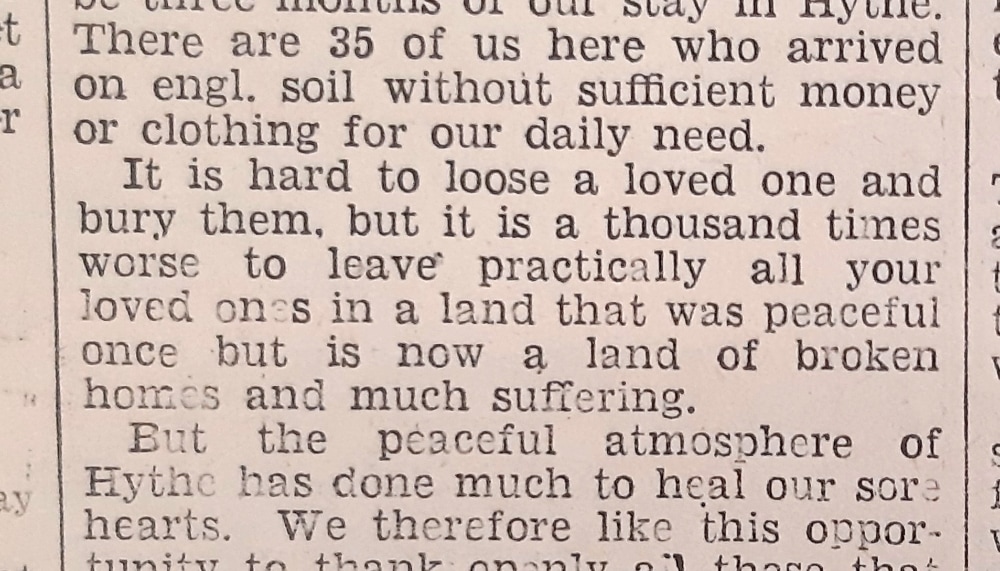
The local newspaper at Hythe, UK, mentions Franz’s refugee group three times between March 18th 1939 and May 20th 1939. These men had left as a group, leaving their families to hopefully come later. They went first because they were more at risk than their families. In one letter to the Folkestone and Hythe newspaper the Czech refugees explain, “It is hard to lose a loved one and bury them, but it is a thousand times worse to leave practically all your loved ones in a land that was peaceful once but is now a land of broken homes and much suffering.”
The Mykura refugee parents were equally inspiring when they moved to the UK. Franz and Franziska Mykura faced the disorienting losses common to all refugees who may lose family networks, family members, language, home, belongings, jobs, income, savings, culture, and role in society. Strength and stability came over time in this family being together. Another advantage was living with or near other German speakers from similar Czechoslovak backgrounds who could offer mutual support. Franz and Franziska remained idealistic in spirit, emphasizing the importance of education to their children, all of whom did well academically.