
Karlsbad 1924 Turnfest (Karlsbad 1924 Gymnastics Festival.)
This is the earliest evidence for Franz organizing a large ATUS sports event.
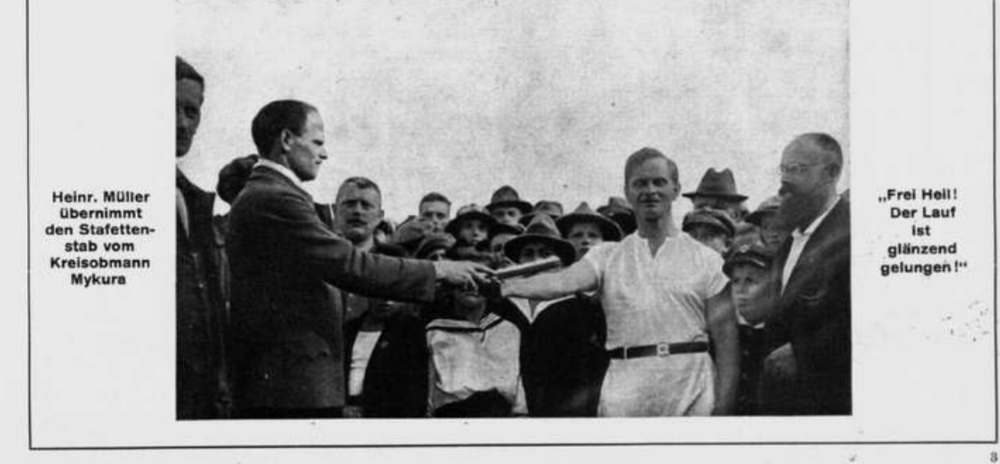
Franz Mykura was in Karlsbad (now Karlovy Vary) at the first large two day workers’ sport event organized by ATUS (Arbeiter Turn und Sportverband, Workers’ Gymnastics and Sports Club in Czechoslovakia.) He is photographed in the programme on page 3 handing the baton to the winner.
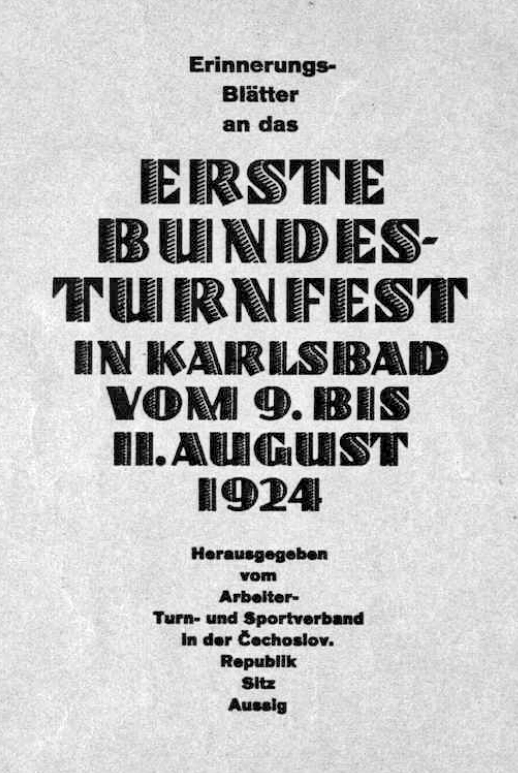
The souvenir programme for the two day event shows Franz was on the committee and was a Kreisobmann (District Umpire.) More than seventy photographs celebrate separate events, from mass displays of schoolchildren, huge processions with flags through the town centre, groups welcomed from other countries, and the range of athletics, gymnastics, dance, swimming and cycling events. This publication is held by the Friedrich Ebert Stiftung (FES) Archive in Germany (PDF).
1925 Marriage of Franziska and Franz Mykura
Franziska Schmiedl (born Franziska Bartl) married Franz Mykura in Falkenau (now Sokolov). She got a new name Franziska Mykura.
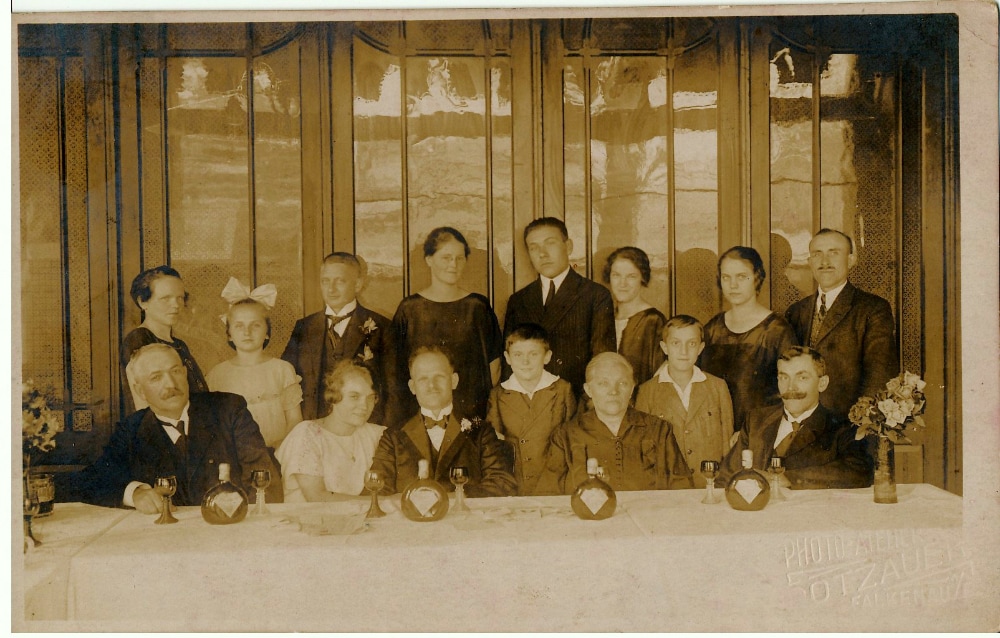
The wedding Photo of Franz Mykura and Franziska Schmiedl has an impressed stamp, bottom right ‘Falkenau’ The venue in Falkenau is not known. There is a table with wine and glasses and large glass doors behind the group with reflections of big window opposite.
Back row , left to right: 1. 2 and 3. not known 4. Eleonore Mykura 5. Not known 6. Anna Mykura 7. Hermine Mykura 8. not known.
Front row: left to right 1.Franz Schmiedl adoptive father of Franziska 2. Franziska Schmiedl (bride) 3. Franz Mykura (groom) 4. Not known 5. Frau Schmiedl adoptive mother of Franziska Schmiedl 6. and 7. Not known
Falkenau Bergarbeiterheim (Falkenau Miners’ Institute) opens in 1925
Now called the Mestsky dum kultury Sokolov (Municipal House of Culture Sokolov), this was a proud and grand new building in 1925.
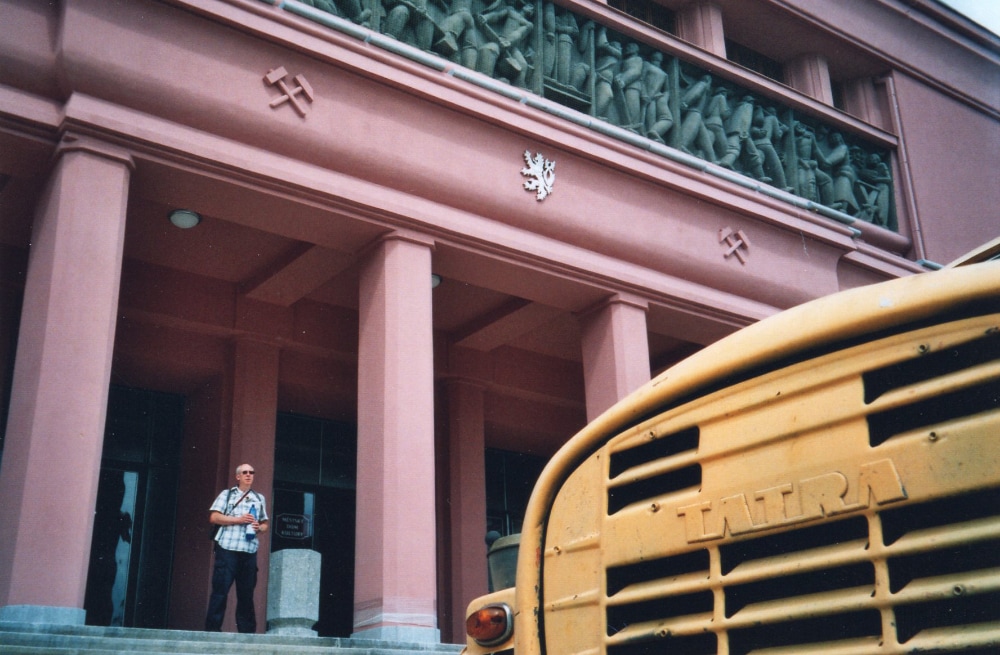
Entrance of what was the old Bergarbeiterheim (Miners’ Institute) as seen in 2006. The two tailed white lion centrally placed under the frieze was the symbol of the Czechoslovakian state. The two-tailed lion also appeared on coins.

In the middle ages the two tailed lion had been the symbol of Bohemia with its capital in Prague. On the Bergarbeiterheim on either side of the two-tailed white lion the symbol for miners and mining is repeated. This is two crossed miners’ tools – the hammer and the pick.
Today the old Bergarbeiterheim is still the major municipal cultural centre in Sokolov. It was an important centre of social, political and cultural life and was in the 1930s a centre of anti-fascist forces until 1938. It had a variety of spaces including meeting and social spaces, a café and an information centre, public baths, a huge hall with stage on the first floor and a basement theatre that seats 350.
The architect of the Bergarbeiterheim was Rudolf Wels who later died in the Theresienstadt concentration camp in Czechoslovakia. The grand entrance is topped by the magnificent frieze that runs across the frontage. ‘One day in the life of a miner,’ sculpted by Wilhelm Srb-Schlossbauer. The relief is ‘read’ from left to right on a lengthwise strip: Saying goodbye to the family, Going to work, Going down the pit in the cage, Hewing coal, Coming up in the cage and returning tools, The way home, and Home again.
Two sons born to Franziska and Franz Mykura
Walter Mykura was born in 1926 and Helmut Mykura was born in 1927.
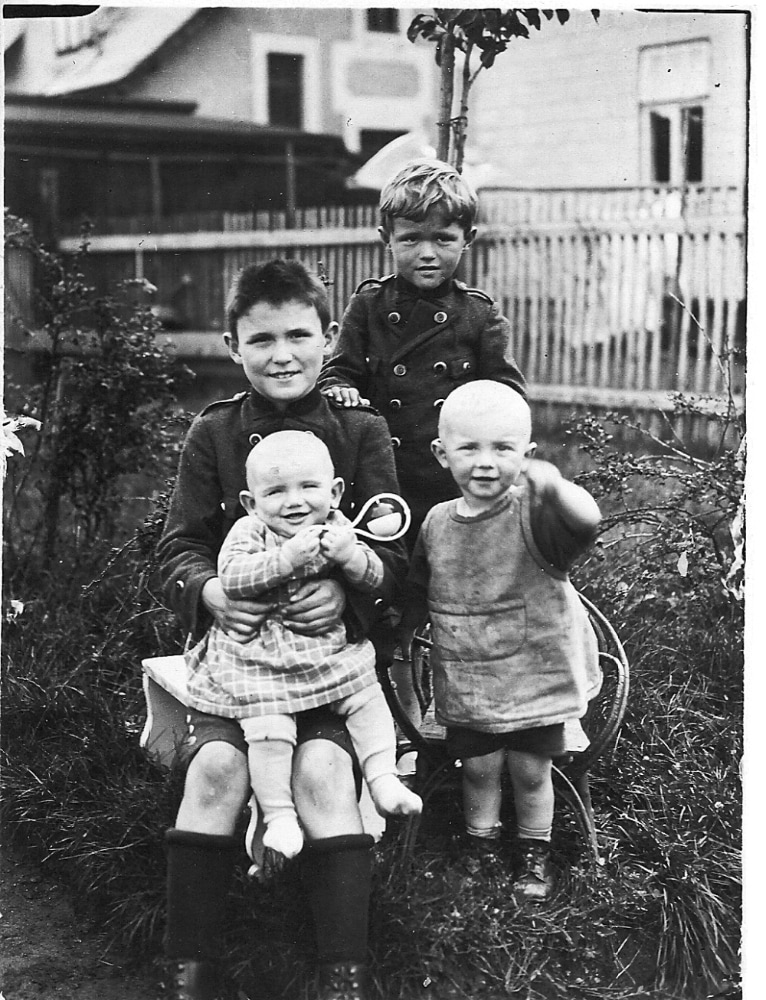
In 1927 the four cousins are two Mykura brothers, Helmut at the front (left) with rattle and Walter at front (right) pointing, pictured with their two Pöpperl cousins Ernst (left) and Franz (right).
Franz and Franziska Mykura live in Falkenau
‘Eingang Lobsweg 28 (Entrance to Lobsweg 28)
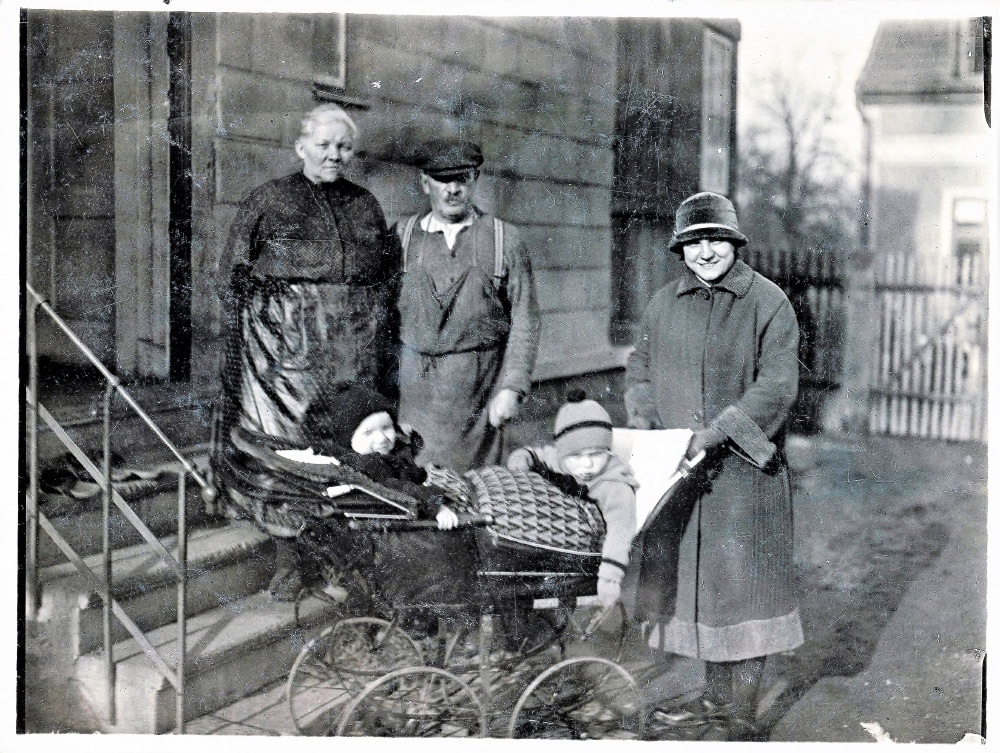
Franziska Mykura is in coat and hat, with a pram containing her two sons, Helmut left and Walter right, warmly dressed outside steps to the house. House slippers are on the step in front of the open door. Her parents Frau and Herr Schmiedl stand on the steps. There is a wintery sun with Franziska’s shadow behind her. A view to the street beyond the picket fence shows another house and a tree in winter. The house and street near the Bergarbeiterheim ( Miners’ Institute) are no longer there, having been replaced by flats. Lobsweg means the ‘way by the Lob’ and the stream called the Lob still flows through Sokolov (formerly Falkenau).
Franz Mykura campaigns for teetotal workers
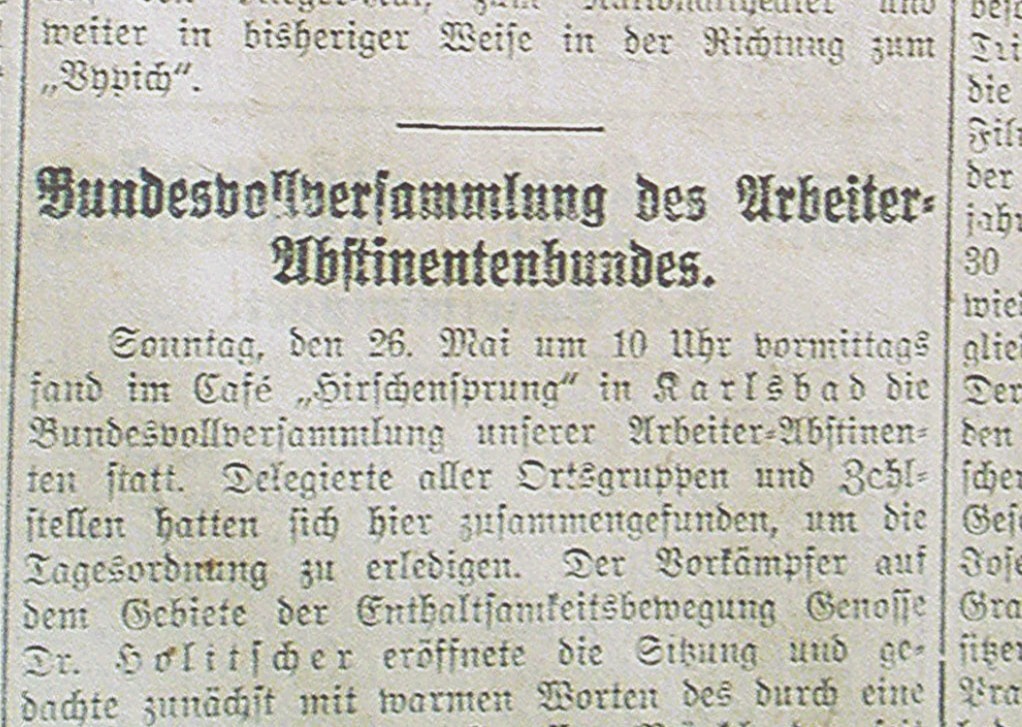
A report in a Social-Democrat newspaper describes the meeting in May 1929 in Karlsbad of the federation of ‘Arbeiter Abstinentenbundes.’ (Workers’ Teetotal Association) The meeting took place in the Café Hirschensprung (translation Café Deers Leap) named after a Karlsbad beauty spot that looks down on to the town.
A long list of attendees sending greetings includes ‘Genosse Mykura für die Turner.’ (Comrade Mykura on behalf of the gymnasts.)
Franziska and Franz bought the Lobsweg house.
Frau Schmiedl sold her half of the property to her adopted daughter Franziska Mykura and her son-in-law Franz Mykura.
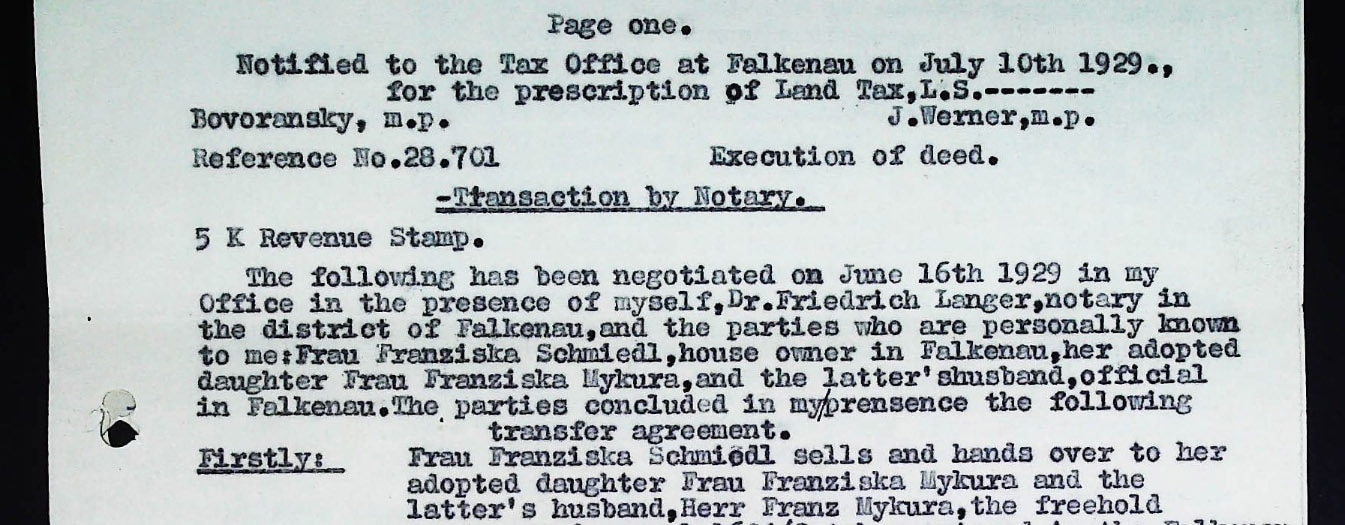
After their marriage Franziska and Franz Mykura bought the property at Lobsweg 28, Falkenau, each having a half share. The house sale combined a formal arrangement of rights and responsibilities The formal house sale was completed in 1929, paid partly in money and partly in kind. The old lady, Franziska’s adoptive mother Frau Schmiedl, was to remain living with them in the Lobsweg 28 property, with practical and financial support from Franz and Franziska until her death. This was stated as ‘sole right of occupation together with free heating and light of the gabel room of the house,’ ‘appropriate and wholesome board at the communal table, or if she so desires in the above mentioned gable room, to give her clothing in accordance to her standing and to pay her weekly pocket money of thirty crowns and to pay all expenses incurred through illness and all funeral arrangements.’
Sadly, the 1929 agreement was broken when in 1938 the Mykura family left Czechoslovakia. Old Frau Schmiedl who initially left her home with Franziska in 1938 could not travel to the UK with the family. After World War Two Franziska found out that her mother had died in 1942 ‘after four sad and lonely years.’