
Franz Mykura was an Austro-Hungarian soldier in World War One
Before and during World War One, Bohemia was in the Austro- Hungarian Empire. Czechoslovakia did not yet exist.

This army photo of a group of soldier gymnasts is dated on the reverse 28-X-1916 (28th October 1916), and includes the words K.u.K.Marine
Franz had become twenty years old in September 1916. Franz Mykura is the third on the left of a line of seven gymnasts wearing sports trousers and tops with sashes round the waist. They stand in front of gymnastic parallel bars which are outside, in front of a large hut, with barbed wire behind the hut.
Franz Mykura served near Pola (also called Pula) on the Adriatic coast, which was part of the Austro-Hungarian Empire. Franz was aged 18 in 1914, but the date he joined the Austro-Hungarian Army as a soldier is not known. Two Austro-Hungarian Army photographs show groups of soldiers including Franz. Both were post-cards sent from Franz with the post mark ‘Pola K.u.K. Marine.’
Pola was the main port of the Austro-Hungarian Navy. K.u.K Marine stands for Kaiserliche und Königliche Marine (Imperial and Royal Navy) which is the name of the Austro-Hungarian navy. Another K.u.K. Naval Base on the Adriatic further south at Cattarro (also called Kotor) was the site of an Austro-Hungarian naval mutiny in 1st February 1918. Naval rations had been reduced in January 1917 and again in January 1918. The mutiny spread to Pola. Both mutinies were put down.
Franz’s UK government file in the UK National archive says, ‘On the outbreak of the first World War MYKURA served in the Austrian Army on a coastal artillery battery, being discharged with the rank of Warrant Officer.’
The unverified, oral family tradition said that Franz’s World War One service was mostly quiet. Food was short and although at times there was a glut of tomatoes, hunger and poor rations were a problem and the commander’s dog was roasted for food on a forge.

Franz Mykura in a group of World War One soldiers
Austro-Hungarian soldiers with dog, accordion and flower sprigs make this a fascinating official group photo.

The reverse has the date ‘23 111’ ie 23rd March, but not the year. An estimate of the year is 1917, but this is not known.
In this group of 17 Austro-Hungarian army soldiers Franz Mykura is at the far back, standing on the right, in a dark jacket. There is a small blue line on the top edge of the photo, above Franz’s head. There is an illegible stamp on the bottom left corner. The well-composed informal group is arranged so everyone was clearly seen; a relatively small group, yet with a big range of ranks among 17 men; the soldiers in uniform, and with small flowers, in hats or buttonholes, perhaps plucked from the bush behind, plus a dog and accordion. The leader, who has no flowers, is seated with the dog and accordion next to him, while the three-star man on the right standing against the rocks is the only one with puttees and stick. The three-star men have their trousers tucked into boots.
Two civilian photos of Franz Mykura survive from this period.
This undated (estimate 1916 when Franz was 20 years old) image is on a stamped and franked post card (date illegible.)

Franz, as a young civilian in a three-quarter length portrait, is formally dressed, with thick, diagonal weave, dark tweed, three-buttoned long overcoat and black homburg hat. The location is unknown; he is standing outside, hands in pocket, with urban background of snowy open ground with winter trees and three-storey building.
The photo is a post card is addressed to Franz’s younger brother Josef Mykura. Franz signed the card ‘Fond Greetings, Franz.’ The Austro-Hungarian postage stamp has the portrait of the Emperor Franz Josef who died in November 1916. It is not known when this stamp was last in usage.
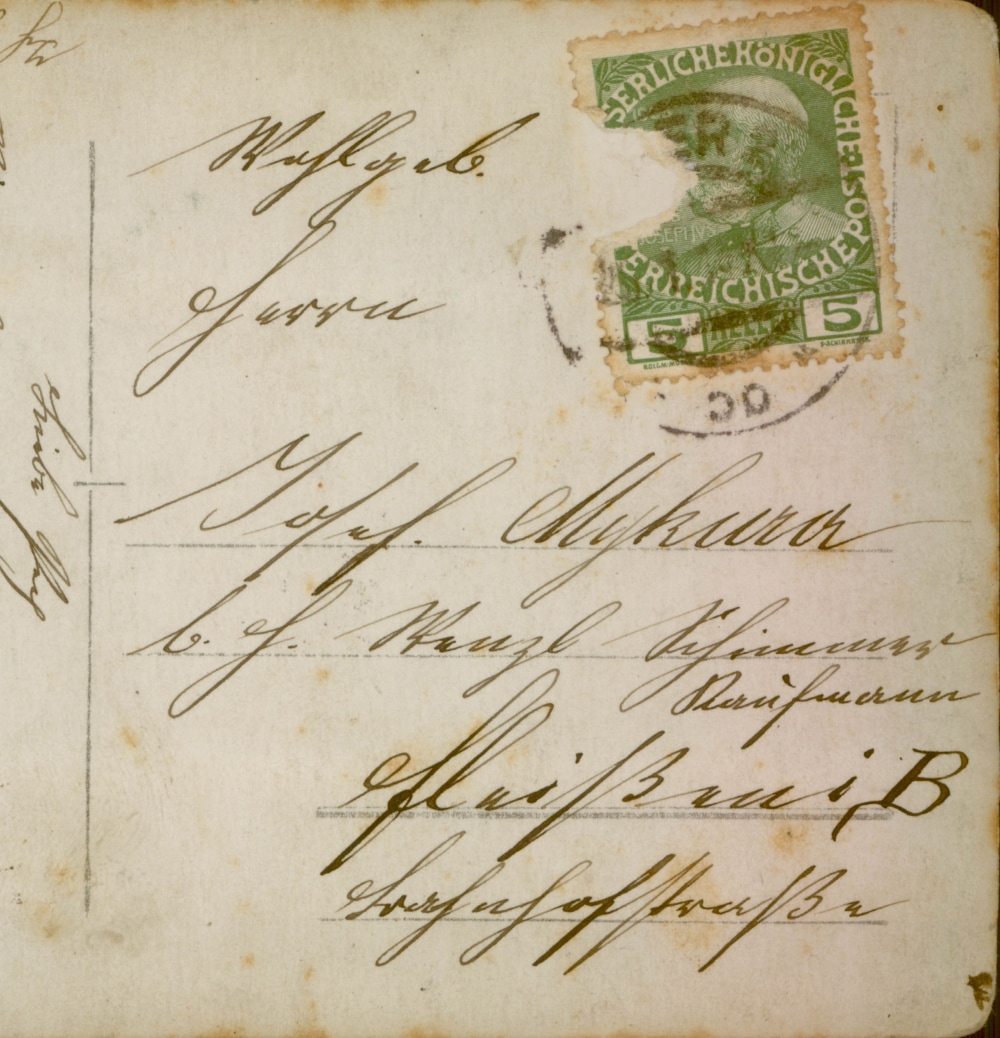
Josef Mykura’s address was in Fleissen (now Plesna ) a village very near the German border on the railway line between Cheb and Plauen. The address is: Herrn Josef Mykura Bei Herrn Wenzl Schimmer Kaufmann Fleissen i B Banhofstrasse. Translation: Mr Josef Mykura Via Mr Wenzl Schimmer, business man, Fleissen i B (in Bohemia), Station Street.
Franziska Mykura in World War One.
She wrote later as part of an essay at her English lessons in Birmingham, UK,
“When I was still in the Elementary School the First World War started. By the end of the war 1918 I was thirteen years old and had joint a “Secondary Modern School.” The war was lost and the old “Austrian Empire” was broken up. Bohemia, called “the Heart of Europe” was now part of “Czechoslovakia.”
No photos of Franziska from this period survive.
Franz a civilian again in 1919 with two sisters.
Franz was 22 years old, with both his parents having died, but he was in contact with his siblings.
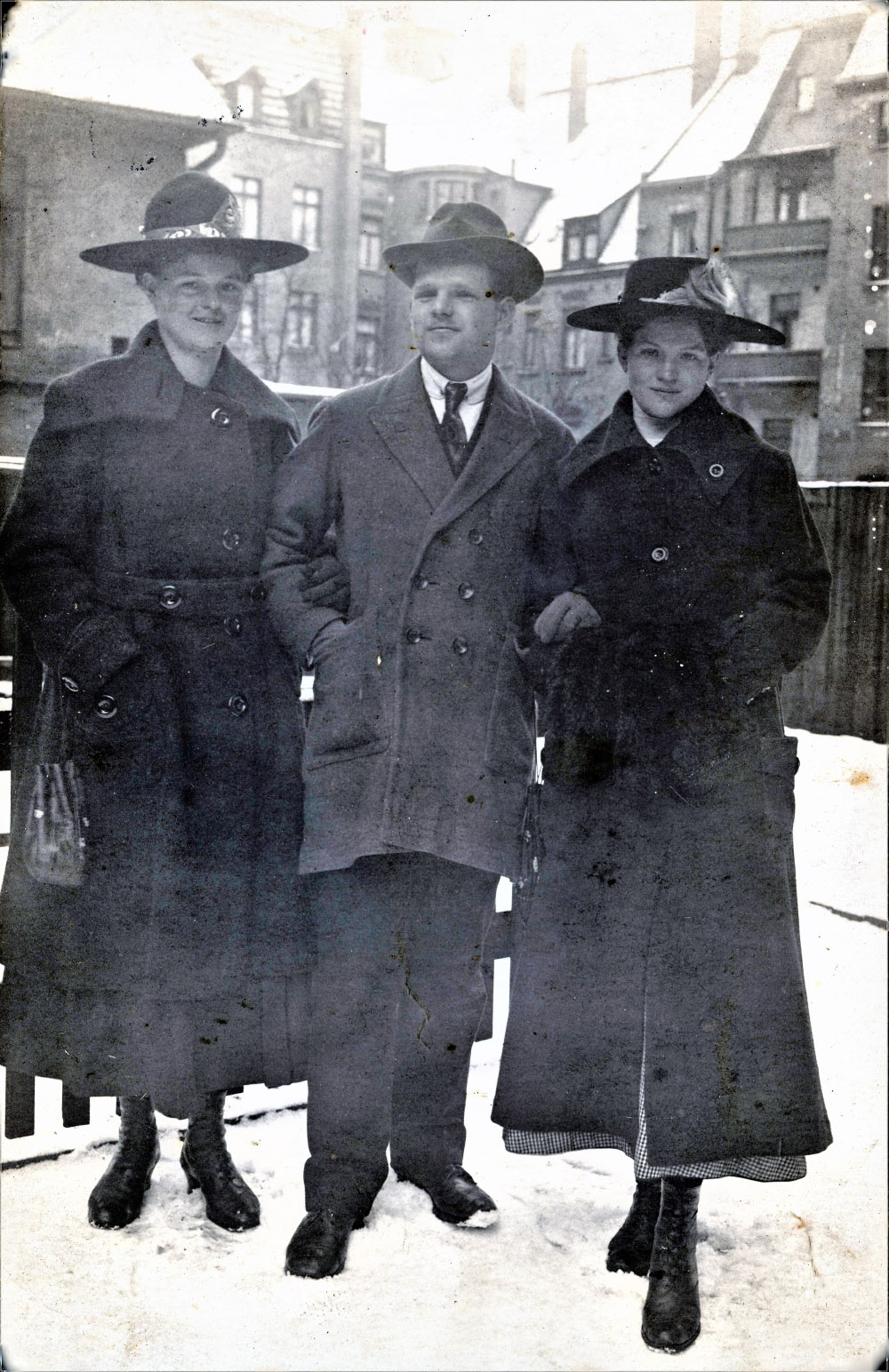
At ‘Weihnachten 1919’ (Christmas 1919) a year after the end of World War One, the three siblings are in Plauen, Germany, a textile town which is across the border from Eger (now Cheb) which is in the new Republic of Czechoslovakia. Left to right are Eleonore (Lore) Mykura (1892-1968), Franz Mykura, (1996-1966) and Anna Mykura (1897-1966) standing arm in arm in snowy street scene, wearing boots, coats, hats, gloves, women each with soft handbag, with a four-storey building behind.