
‘Workers’ sport’ or elite sports?
After World War One ‘workers’ sport’ became a means of political community organization designed to develop mutual support and empower the community. It was developed in contrast to the alternative ‘elite sport’ model where audiences watched elite professional athletes, but did not participate themselves. In contrast ‘workers’ sport’ was a community activity for large numbers and all ages. It was wider than sport and incorporated cultural events with mass participation. Workers’ sports facilities were owned and run by the organisations themselves.
Workers’ sport included outdoor and indoor sports events, from cycling to skiing, football to athletics, gymnastics, sports leagues, processions, political talks, May Day events, marches, choirs, festivals, women’s events, children’s events, stage shows, occasional large regional multi-day multi-sports events and international workers’ summer and winter Olympiads. Local political party newspapers reported these events.
Workers’ sport in Czechoslovakia, built on the popularity of gymnastics as a sport in 19th century Bohemia. Both Czech-speaking and German-speaking separate workers’ gymnastics and sports organisations continued to be popular in Czechoslovakia, the new country created after World War One. The Czech-speaking social-democratic sports organization was called Dělnická tělocvičná jednota. (DTJ) Both ATUS and DTJ attended international events.

The 1938 post card addressed to the Mykura boys has a Czech stamp celebrating the 19th c gymnast’s leader Jindřich Fügner who was founder of the SOKOL, which was a large, Czech-speaking nationalist gymnastics association.
ATUS and workers’ sport in Czechoslovakia
Meaning of the name ATUS Union The Workers’ Gymnastics and Sports Association used the initials to make the name ‘ATUS.’ ‘Union’ in German means ‘association.’
A – Arbeiter (Workers,) T – Turn (Gynmnastics,) U – Und (And,) S – Sportverein, (Sports club.)

Both Franz and Franziska (Fanni) Mykura worked for ATUS, the Czech German-speaking workers’ sports organization, which was sponsored by the DSAP ‘Der Deutschen Sozialdemokratischen Arbeiterpartei in der Tschechoslowakei‘ (The German Social Democratic Workers‘ Party of Czechoslovakia.‘) ATUS was banned by the Nazis after October 1938 and the ATUS sports facilities were confiscated.
The role of women in ATUS.
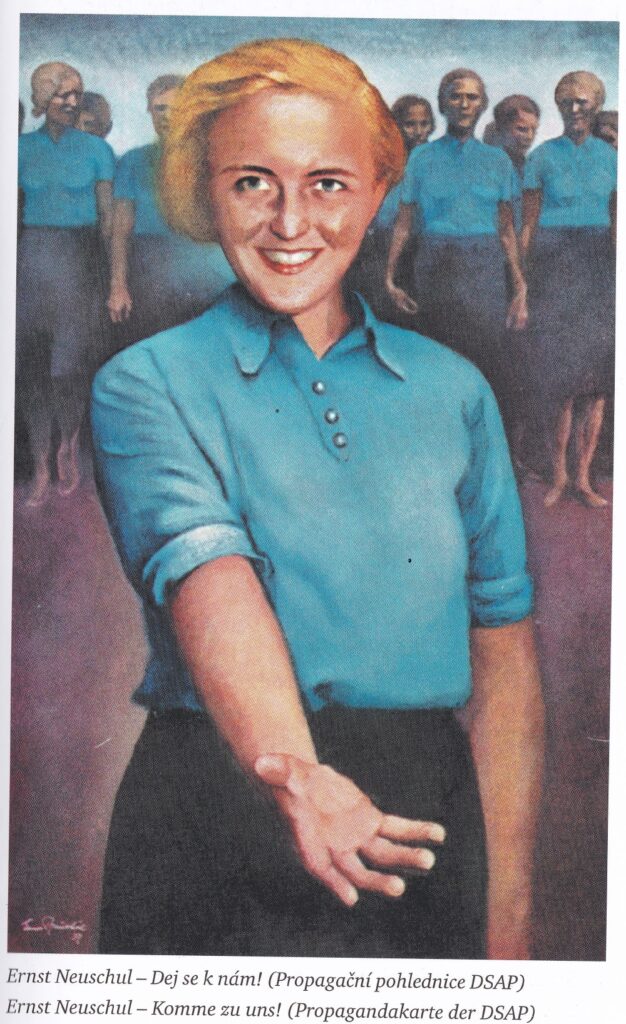
The DSAP propaganda card with women in blue shirts was painted by Czech artist from Aussig (now Ústí nad Labem) Ernst Neuschul. He left Czechoslovakia as a refugee in March 1939 travelling to the UK. Ernst Neuschul was helped by the same UK member of Parliament, David Rhys Grenfell MP, who had escorted Franz Mykura’s group of refugees to safety in October 1938.
Most of the work of DSAP women was in communities, building solidarity through community events such as ATUS events described in Key Documents Three and Four. However large events were also successful, such as the ‘Frauen Aufmarsch 1934 in Falkenau,’ (Women’s March 1934 in Falkenau) An image of thousands of women lined up in rows with a clenched fist salute probably shows preparation before setting off in the Falkenau Frauenaufmarsch through the town.
https://zumfeindgemacht.de/wp-content/uploads/2024/06/Frauenaufmarsch_1934_in_Falkenau.jpg
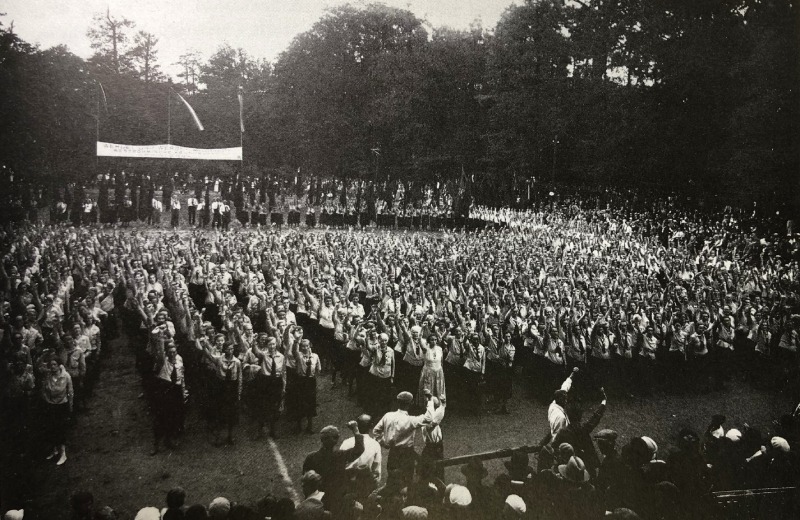
In addition the children’s and the Socialist Youth groups came to Falkenau for the 1934 Women’s March creating an enthusiastic event that lined the streets. A description noted that 3,500 women with their blue blouses and red cravats, and the gymnasts in white, created a fine picture. See the Decade 1930s section for another photo ‘Social-democrat women on the March’ of these women in the centre of Falkenau with flags and banners.
See also Key Document Three for details of workers’ sports events involving both Franziska and Franz Mykura: Reports in a local Czech social-democrat newspaper ‘Volkswille’ These include a report of an ATUS Women’s Regional Conference in 1936, when Franziska Mykura was voted in as chairperson, and a report of Franz Mykura leading a one-day ATUS Cycling Festival in 1938.
See also Key Document Four for details of workers’ sports events involving both Franziska and Franz Mykura: : Reports in a local Czech social-democrat newspaper ‘Volkswille’ These include Franziska’s attendance at an ATUS Working Women’s Meeting with stage show in a nearby industrial small town in 1936 and a report of Franz Mykura at an ATUS Workers’ Football Conference in 1937.
Thank you to to Michael Rund at Sokolov (formerly Falkenau) Museum and to Herr Dieter Kühnl from Munich for 1930’s extracts in Key Documents Three and Key Document Four from the local social-democrat newspaper Volkswille naming Franziska Mykura, (1905 -1965) who was an activist in 1930’s Czechoslovakia in the DSAP sponsored sports organisation called ATUS.